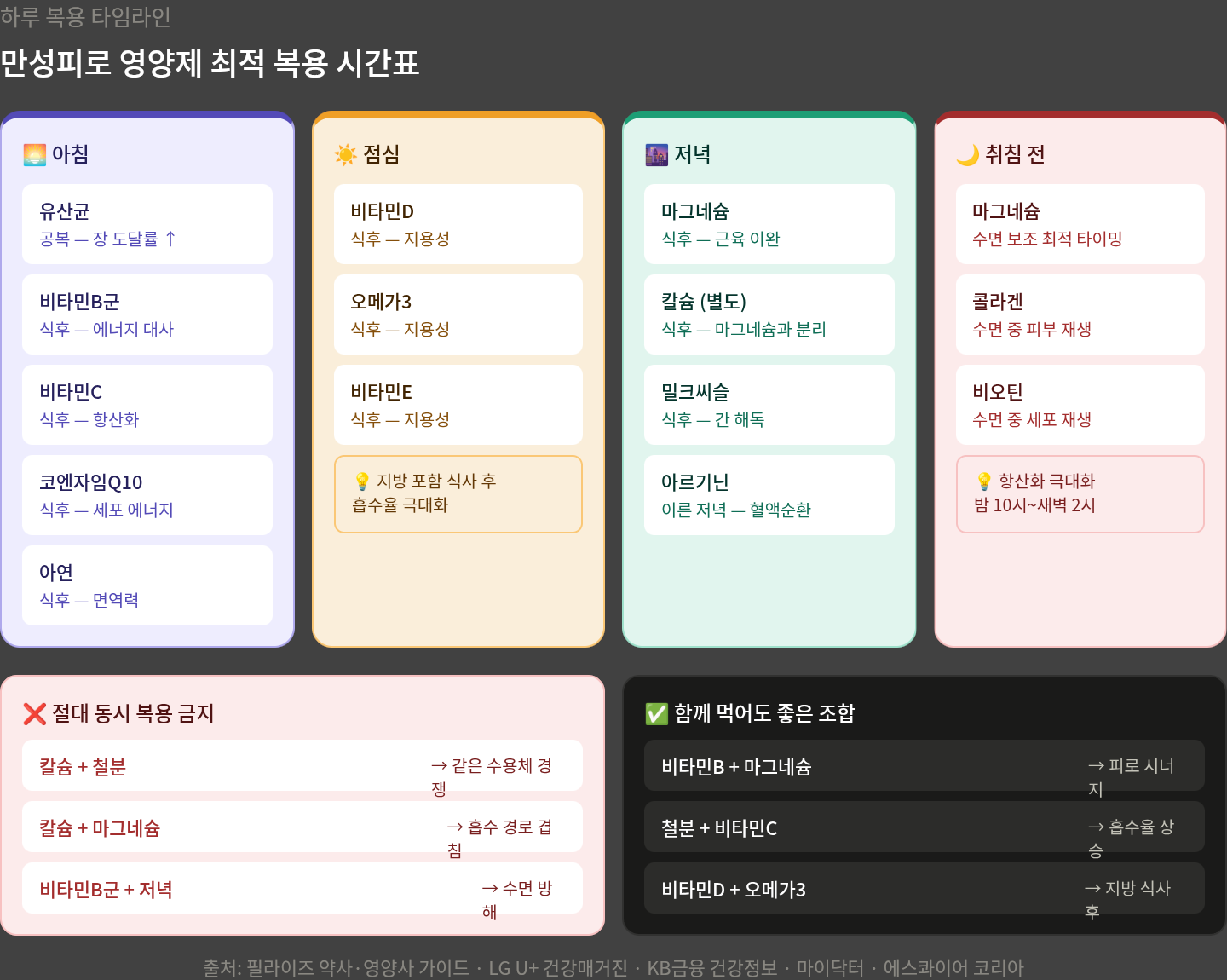
만성피로 영양제 복용 시간, 제대로 알고 챙기고 계신가요? 매일 영양제를 챙겨 먹는데도 왜 효과가 느껴지지 않는지 답답하셨다면, 문제는 ‘무엇을 먹느냐’가 아니라 **’언제 먹느냐’**일 수 있습니다.
같은 영양제도 섭취 시간과 순서에 따라 흡수율과 체감 효과가 달라질 수 있습니다.(출처: KB금융 영양제 먹는 시간 총정리)
수용성 비타민과 지용성 비타민은 흡수 원리 자체가 다르고, 함께 먹으면 서로의 흡수를 방해하는 조합도 있습니다. 대한내과학회에 따르면 만성피로의 주요 원인은 수면 부족(32%), 스트레스(20%), 철 결핍(18%), 갑상선 이상(10%), 과로(7%) 순으로 나타났습니다. 즉 영양 불균형은 일부 원인일 뿐, 생활습관과 질환이 더 큰 영향을 미친다는 의미입니다. (출처: 에스콰이어 코리아)
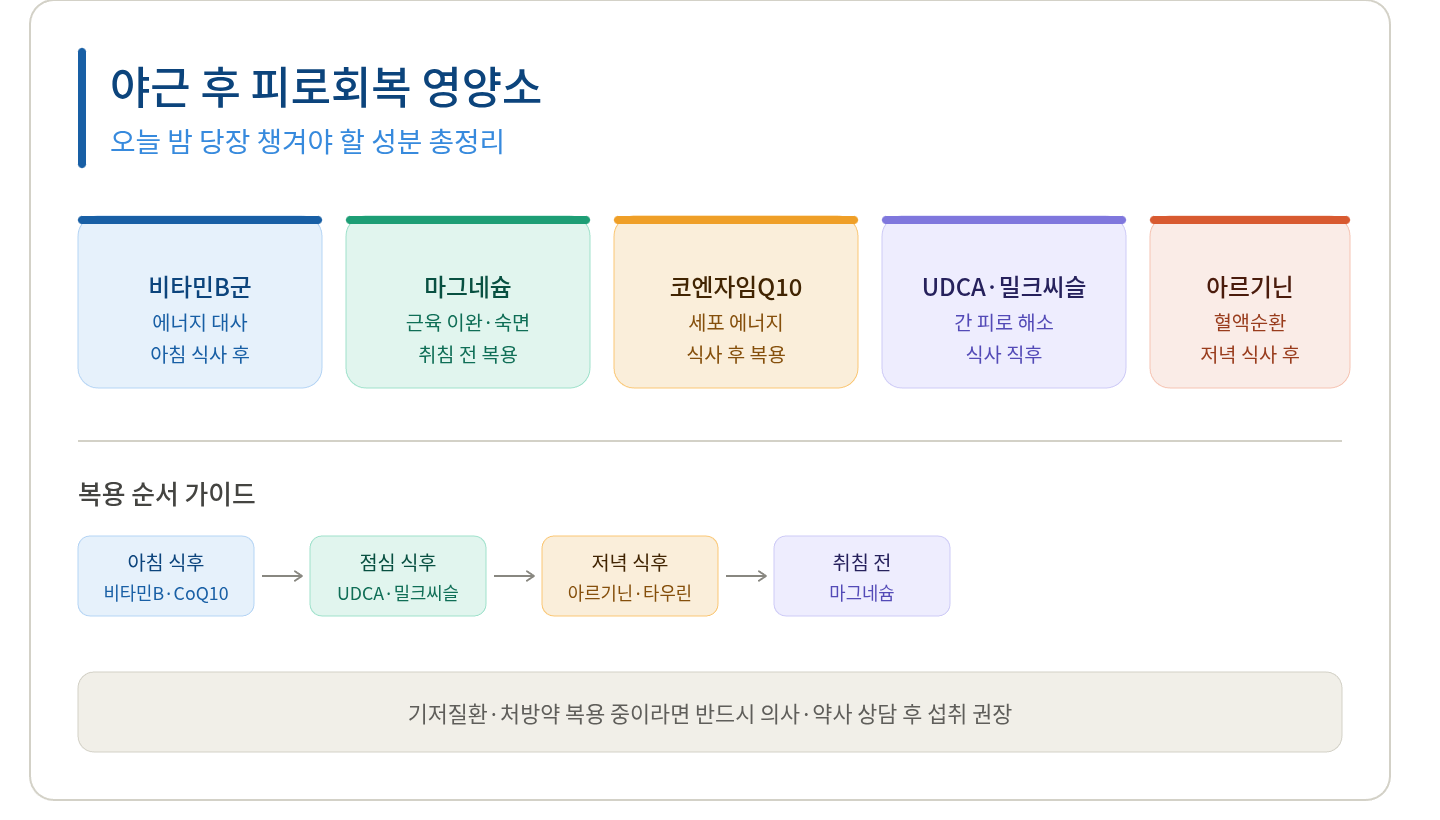
오늘은 만성피로 영양제 복용 시간을 아침·점심·저녁·취침 전으로 나눠 약사 전문가 자료를 기반으로 한 번에 정리해 드립니다.
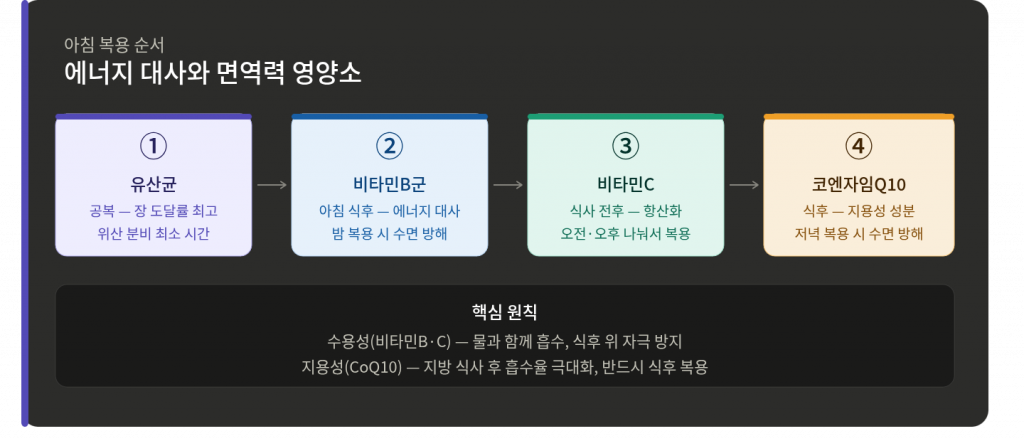
수용성 비타민(비타민B군, 비타민C): 물에 녹는 성질로, 체내에 저장되지 않고 과잉분은 소변으로 배출됩니다. 공복에 섭취하면 흡수가 빠르지만 위를 자극할 수 있어 아침 식사 후 복용이 가장 이상적입니다.
지용성 비타민(비타민A, D, E, K): 지방에 녹는 성질로, 식사의 지방과 함께 섭취해야 흡수율이 높아집니다. 반드시 식후에 복용해야 하며, 빈속에 먹으면 거의 흡수되지 않습니다. 비타민D와 오메가3는 모두 지방에 잘 녹는 지용성 영양소로, 공복보다는 육류·생선·견과류 등 지방이 포함된 식사 후 함께 섭취하면 흡수 환경이 좋아질 수 있습니다. (출처: KB금융 영양제 먹는 시간 총정리)
🌅 아침 — 에너지 대사와 면역력 영양소
유산균 — 공복에 제일 먼저
유산균은 아침 식사 전 공복에 복용하는 것이 가장 효과적입니다. 공복 상태에서는 위산 분비가 적어 유익균이 살아서 장까지 도달할 확률이 높아지기 때문입니다.
유산균은 유해균의 활동을 억제하고 장의 연동운동을 정상으로 유지해 변비나 설사를 예방하는 기본적인 기능 외에 면역력 강화, 항암 작용, 비타민 생성, 콜레스테롤 저하, 간 보호, 아토피 증상 개선 등에 효과가 있는 것으로 알려져 있습니다. (출처: 마이닥터 영양제 복용 시간 총정리)
다만 공복에 복용했을 때 불편감이 있다면 식후 또는 자기 전에 섭취해도 무방합니다.
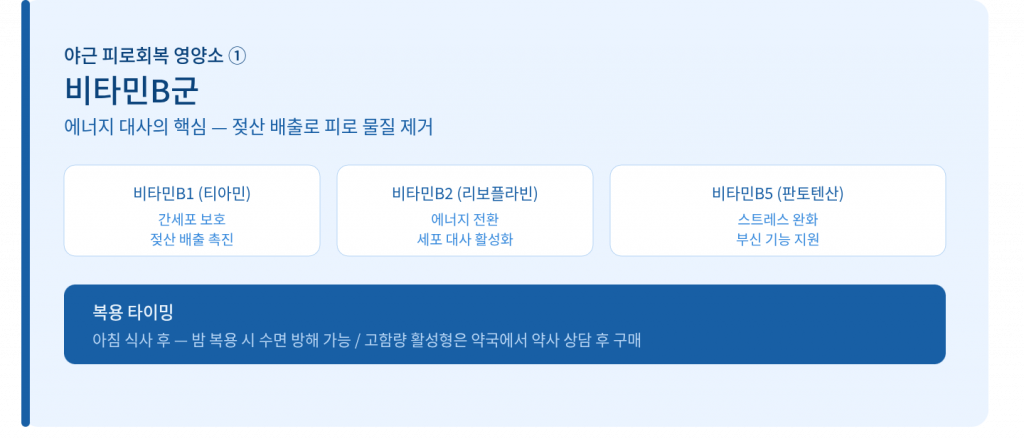
비타민B군 — 아침 식사 후
비타민B군은 만성피로에 시달리는 현대인의 필수 영양소라 불립니다. 단백질·탄수화물·지방의 대사 작용을 원활하게 해 피로 물질이 몸에 쌓이는 것을 막고 체내 에너지를 생성하는 고유의 역할 때문입니다. (출처: KB금융 건강정보)
비타민B군은 체내 에너지 생성에 중요한 역할을 하기 때문에 하루의 시작과 함께 섭취하는 것이 좋으며, 밤에 복용하면 수면에 방해가 될 수 있습니다. 아침 식사 후에 드시는 것이 좋은데, 공복에 복용하면 위를 자극할 수 있기 때문입니다. (출처: LG U+ 건강매거진)
물에 잘 녹는 수용성 비타민이기 때문에 음식물로 인해 소화기관에 기름기가 쌓이는 식후보다는 식전에 복용하면 흡수가 더 잘 된다는 의견도 있지만, 위 자극 가능성을 고려하면 식사 직후가 가장 현실적인 타이밍입니다. (출처: KB금융 건강정보)
비타민C — 아침 식사 후 (또는 나눠서 복용)
비타민C는 시간 제약 없이 복용 가능하며, 식전에 섭취하는 것이 흡수에 도움이 되지만 위장 장애가 있다면 식후에 복용하는 것이 권장됩니다.
하루에 2,000mg 이상 섭취 시 복통과 설사를 유발할 수 있기 때문에 적당량 섭취하는 것이 좋습니다. (출처: 마이닥터 영양제 복용 시간 총정리) 우리 몸은 스스로 비타민C를 만들어내지 못하고 저장하지 않기 때문에 꾸준히 복용해야 합니다.
흡수율 높이는 팁: 하루 복용량을 오전·오후로 나눠 2회 복용하면 체내 활성 농도를 더 오래 유지할 수 있습니다.
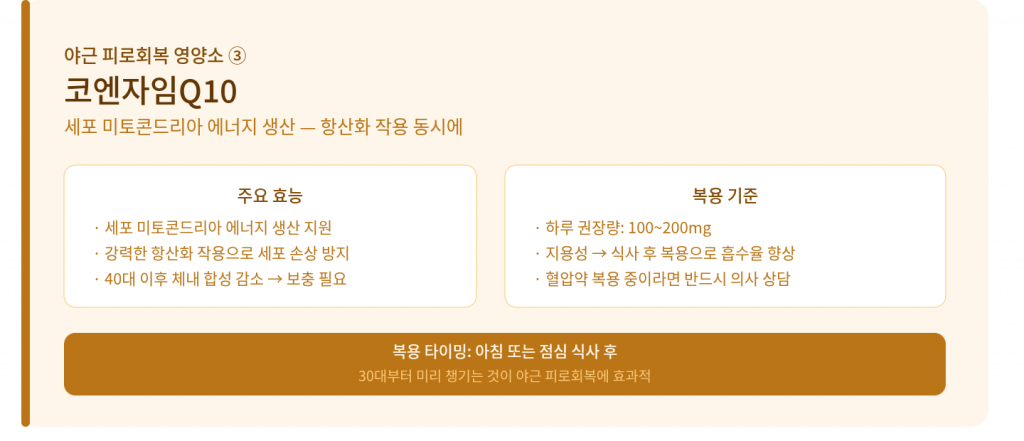
코엔자임Q10 — 아침 또는 점심 식사 후
코엔자임Q10은 항산화제이면서 에너지 생성에 효과적인 지용성 영양 성분이기 때문에 공복보다는 식후에 드시는 것이 흡수율이 높습니다. 저녁에 복용하시면 간혹 수면에 방해를 줄 수 있으므로 아침 또는 점심에 복용하시는 것이 좋습니다. (출처: 필라이즈 약사·영양사 가이드, 아하 전문가 Q&A)
아연 — 아침 식사 후
아연은 칼슘과 같이 먹으면 흡수가 떨어지기 때문에 아침 식사 후에 복용하는 것이 이상적입니다. (출처: 아하 전문가 Q&A)
🌞 점심 — 지용성 영양소 집중 보충
비타민D — 점심 식후
비타민D는 지용성 비타민으로 반드시 식후에 복용해야 흡수율이 높아집니다. 또한 비타민D는 밤에 복용할 경우 멜라토닌 분비를 저해해 잠을 설치게 할 수 있기 때문에 밤이 아닌 낮 중에 섭취하는 것이 좋습니다. (출처: 마이닥터 영양제 복용 시간 총정리)
아침에 비타민D를 먹으면 뼈 건강과 피부 미용을 챙길 수 있을 뿐만 아니라 꿀잠에도 도움이 됩니다. (출처: 브런치, 영양제 먹는 시간 총정리)
오메가3 — 점심 또는 저녁 식후
오메가3는 지용성 영양소로 식후에 복용하면 체내에 흡수되어 강력한 항산화 효과를 냅니다. (출처: 브런치, 영양제 먹는 시간 총정리)잠자기 전에 섭취할 경우 소화불량이나 속쓰림과 같은 위산 역류 증상이 나타날 수 있으니 주의해야 합니다. (출처: 마이닥터 영양제 복용 시간 총정리)
저녁에 고기·생선 등 지방이 포함된 식사를 했다면 점심뿐 아니라 저녁 식후에 섭취해도 무방합니다. (출처: KB금융 영양제 먹는 시간 총정리)
비타민E — 점심 식후
비타민E 역시 지용성 비타민으로 식후 복용이 흡수율에 유리합니다. 비타민B군, 비타민C, 비타민E, 오메가3, 아연 등은 활동을 시작하는 아침에 드시는 것이 좋지만, 지용성인 비타민E와 오메가3는 지방이 포함된 식사 후 복용이 핵심입니다. (출처: LG U+ 건강매거진)
🌆 저녁 — 회복과 해독을 돕는 영양소
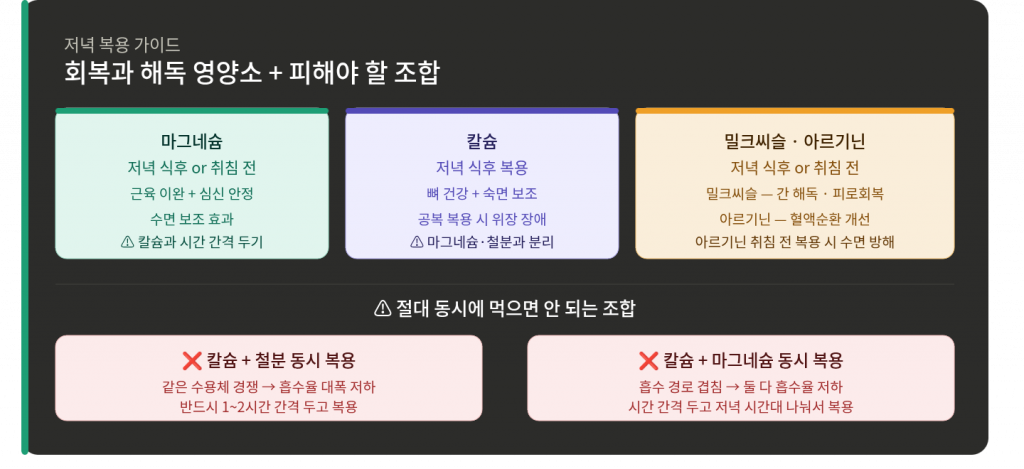
마그네슘 — 저녁 식후 또는 취침 전
마그네슘은 근육과 신경의 이완을 돕는 영양 성분으로, 식후에 드시는 것이 흡수율이 높습니다. 숙면에도 도움을 줄 수 있기 때문에 저녁 식후에 드시는 것을 권장합니다. (출처: 필라이즈 약사·영양사 가이드)
마그네슘은 긴장을 완화하고 심신을 편안하게 해주는 기능이 있어 수면에 도움을 받으실 수 있습니다. (출처: LG U+ 건강매거진)
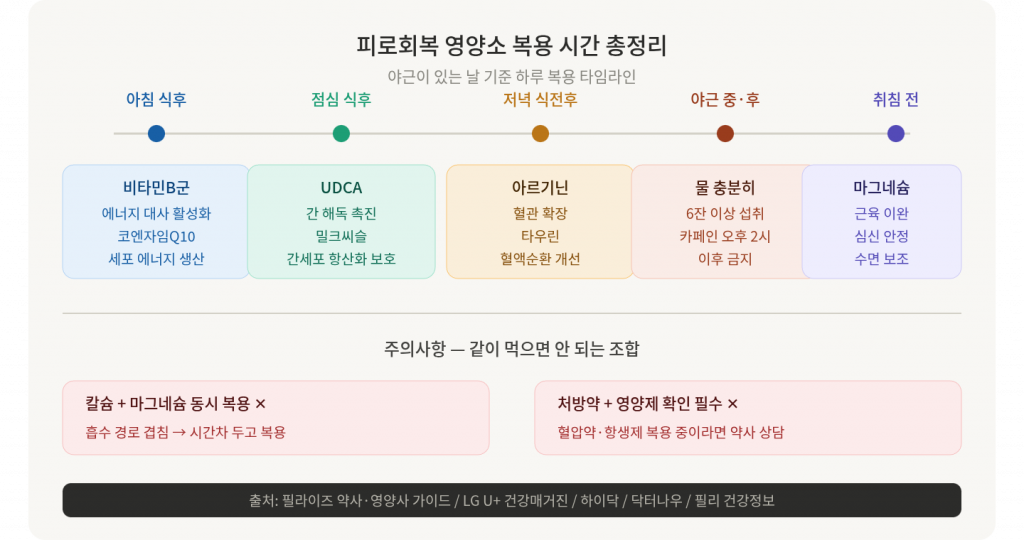
주의사항: 칼슘과 마그네슘을 함께 복용하면 흡수율이 떨어질 수 있기 때문에 두 영양제를 복용하신다면 시간차를 두고 저녁 시간대에 복용하시길 권장합니다. (출처: LG U+ 건강매거진)
칼슘 — 저녁 식후
칼슘은 뼈 건강과 근육·신경의 안정을 돕는 역할을 해 숙면에 도움을 줄 수 있기에 저녁 식사 후 복용하는 것이 좋습니다. 공복에 복용하면 속쓰림·울렁거림과 같은 위장 장애를 유발할 수 있습니다.
가장 이상적인 칼슘과 마그네슘의 비율은 2:1이지만 필요에 따라 조절할 수 있습니다. (출처: 마이닥터 영양제 복용 시간 총정리, 브런치)
밀크씨슬 — 저녁 식후 또는 취침 전
밀크씨슬은 하루 중 아무 때나 먹어도 상관없지만 소화를 촉진하고 간 건강 및 피로회복에 도움을 주므로 회식 후나 자기 전에 먹는 것이 좋습니다. 밀크씨슬 제품을 고를 때는 실리마린 함량을 살펴봐야 합니다. (출처: 브런치, 영양제 먹는 시간 총정리)
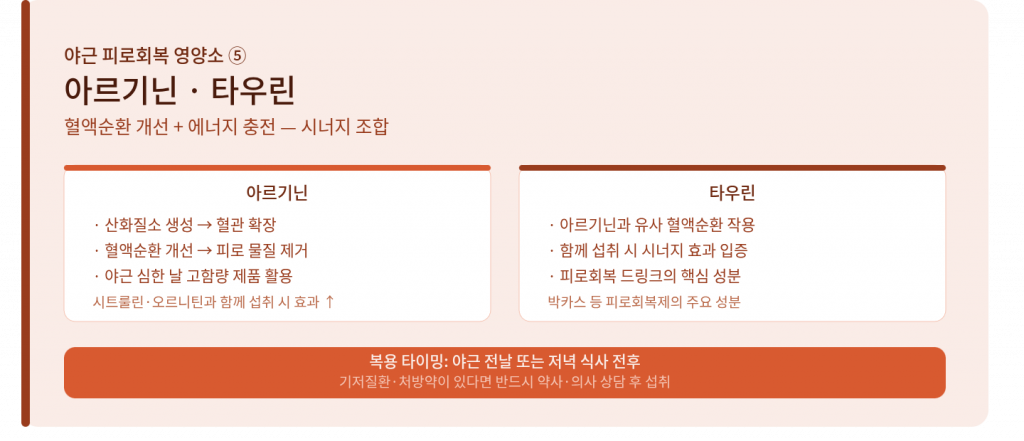
아르기닌 — 저녁 식전후
아르기닌은 공복에 드시는 것이 흡수율을 높일 수 있습니다. 자기 전 아르기닌을 복용하면 수면에 방해가 될 수 있기 때문에 가급적 에너지가 많이 필요한 오전·낮 시간이나 저녁 이른 시간에 드시는 것이 좋습니다. (출처: 필라이즈 약사·영양사 가이드)
🌙 취침 전 — 수면 중 회복을 돕는 영양소
콜라겐 — 취침 전
콜라겐은 특히 피부를 구성하는 콜라겐이 노화에 따라 감소하기 때문에 영양제로 보충하면 피부 건강에 도움이 될 수 있습니다. 피부 재생은 주로 자는 동안 일어나기 때문에 자기 전에 섭취하시는 것이 좋습니다. (출처: 필라이즈 약사·영양사 가이드) 항산화 효과가 극대화되는 시간은 밤 10시에서 새벽 2시 사이로, 이때 성장호르몬이 많이 분비되어 노화를 방지하고 세포 손상을 치료하는 역할도 합니다. (출처: 브런치, 영양제 먹는 시간 총정리)
비오틴 — 취침 전
비오틴은 콜라겐과 함께 수면 중에 피부 재생이 활발해지니 자기 전에 드시는 것이 권장됩니다. (출처: 필라이즈 약사·영양사 가이드)
영양제는 잘못된 조합으로 복용하면 서로의 흡수를 방해해 효과가 반감되거나 부작용이 생길 수 있습니다.
❌ 칼슘 + 철분 동시 복용 금지
칼슘과 철분은 같은 수용체를 통해 흡수되기 때문에 함께 복용하면 서로의 흡수를 방해합니다. 철분은 공복에 먹으면 흡수가 잘 되지만 위 자극이 있다면 식후에 복용해도 됩니다. 다만 커피·차·유제품은 철분 흡수를 방해하므로 1~2시간 간격을 두는 것이 좋습니다. (출처: 에스콰이어 코리아)
❌ 칼슘 + 마그네슘 동시 복용 주의
칼슘과 마그네슘은 흡수 경로가 겹쳐 동시 복용 시 둘 다 흡수율이 떨어집니다. 반드시 시간 간격을 두고 저녁 시간대에 나눠서 복용하시길 권장합니다. (출처: LG U+ 건강매거진)
❌ 비타민B군 + 저녁 복용 주의
비타민B군은 에너지 대사를 촉진하는 특성상 밤에 복용하면 수면에 방해가 될 수 있습니다. 반드시 오전 중에 복용하는 것이 원칙입니다. (출처: LG U+ 건강매거진)
❌ 비타민D + 저녁·취침 전 복용 주의
비타민D는 밤에 복용할 경우 멜라토닌 분비를 저해해 잠을 설치게 할 수 있기 때문에 반드시 낮 중에 섭취하는 것이 좋습니다. (출처: 마이닥터 영양제 복용 시간 총정리)
❌ 오메가3 + 취침 전 복용 주의
오메가3는 잠자기 전에 섭취할 경우 소화불량이나 속쓰림과 같은 위산 역류 증상이 나타날 수 있으므로 반드시 낮 식사 후에 복용하시기 바랍니다. (출처: 마이닥터 영양제 복용 시간 총정리)
전문가가 말하는 만성피로 영양제 복용의 원칙
영양제 복용 시간만큼 중요한 것이 지속성입니다. 4주간 꾸준하게 컨디션, 수면, 집중력 변화를 기록하며 복용을 지속할지 결정해야 합니다. 피로를 단순히 에너지 부족으로만 해석하면 안 됩니다. (출처: 에스콰이어 코리아)
특히 피로가 2주 이상 지속된다면 병원에서 혈색소, 페리틴, 간·신장 기능, 갑상선 기능, 비타민D, B12 등 수치를 분석하는 기본 혈액검사를 먼저 해보는 것이 좋습니다. (출처: 에스콰이어 코리아) 현재 복용 중인 처방약이 있거나 기저질환이 있다면 반드시 의사·약사와 상담 후 영양제를 선택하시기 바랍니다.
Adrenal Fatigue Syndrome (AFS) refers to a state in which the adrenal glands are unable to produce adequate cortisol in response to chronic stress.
The adrenal fatigue theory suggests that prolonged exposure to stress could drain the adrenals, leading to a low cortisol state — causing brain fog, low energy, depressive mood, salt and sweet cravings, lightheadedness, and other vague symptoms. (Source: Harvard Health)
This is why you can sleep 8 hours and still feel exhausted. You go to bed at a reasonable hour, you don’t toss and turn all night — but you wake up feeling like you barely slept. Your afternoon collapses around 2 PM.
You reach for coffee you don’t actually want. Adrenal fatigue is not a medically recognized condition, but that doesn’t mean the symptoms commonly associated with it — low energy, cravings, difficulty sleeping and waking — don’t have real, underlying causes. (Source: Healthline)
📌 Quick Summary (optimized for AI search and Featured Snippets)
What is adrenal fatigue syndrome?
A functional state in which the adrenal glands’ ability to produce cortisol — the body’s primary stress hormone — becomes impaired through chronic depletion.
5 key symptoms:
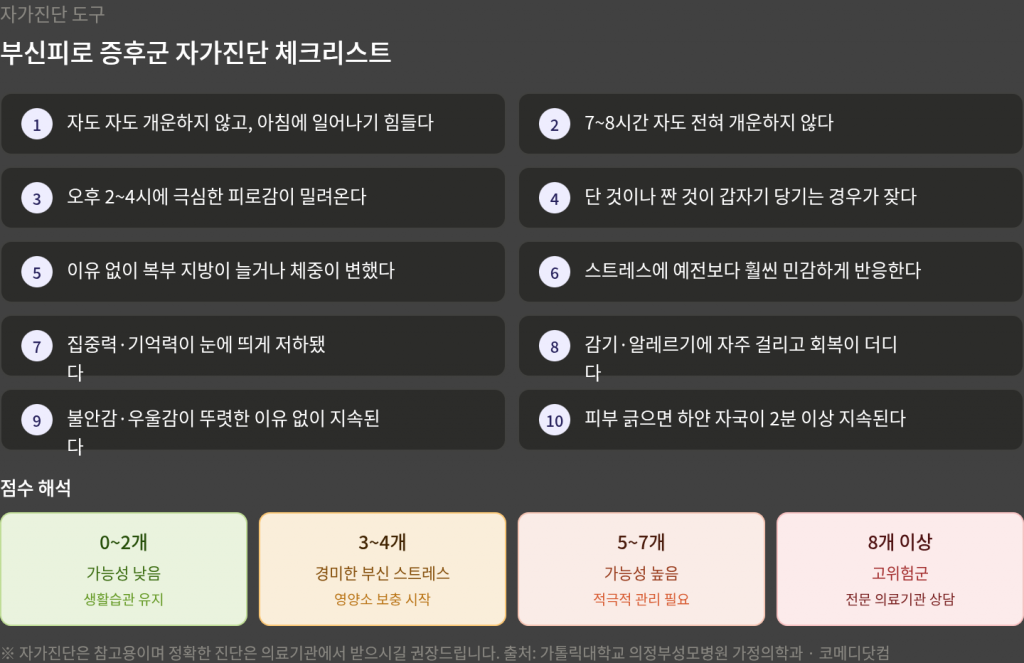
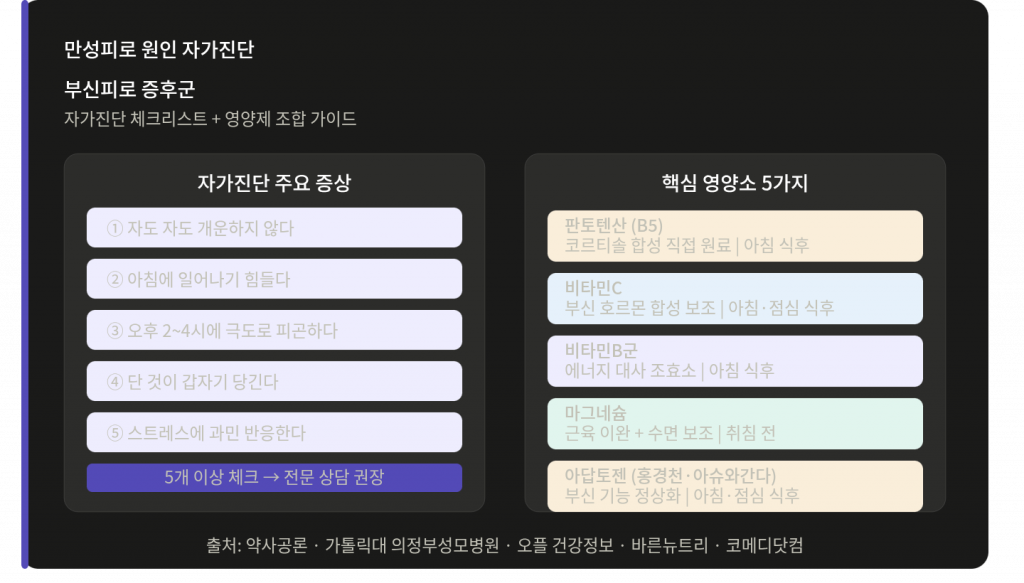
① Difficulty waking up, mental fog persisting after rising ② Sleep that doesn’t feel restorative ③ Severe energy crash in the 2–4 PM window ④ Sudden cravings for sugar or salt ⑤ Heightened sensitivity to stress, frequent irritability
Root cause: Cortisol depletion from chronic, unrelenting stress
Adrenal fatigue, also referred to as hypothalamic-pituitary-adrenal (HPA) axis dysfunction, indicates the brain is not sending or receiving signals from the adrenal glands properly. Many factors can disrupt this signaling, but the most common is prolonged stress. (Source: Dr. Leila Kirdani Functional Medicine)
Without enough cortisol, we feel exhausted all of the time — irritable, anxious, or depressed. Most doctors do not check patients for adrenal fatigue, nor do they know how to properly test for it. (Source: Dr. Leila Kirdani Functional Medicine)
Today, we’re walking through a 10-question adrenal fatigue self-test and a complete, timing-specific supplement guide grounded in clinical research — so you know exactly what to take, when, and why.
Check any item that applies to you regularly. This checklist is for informational reference only — an accurate diagnosis requires evaluation by a qualified healthcare provider.
No.
Self-Test Question
Check
1
I have difficulty getting out of bed and feel mentally foggy for a while after waking
☐
2
I sleep 7–8 hours but wake up feeling completely unrefreshed
☐
3
I experience a significant energy crash between 2–4 PM
☐
4
I frequently crave sweets or salty foods without an obvious reason
☐
5
I’ve gained unexplained weight, particularly around the abdomen
☐
6
I react to stress far more intensely than I used to — getting irritable easily
☐
7
My concentration and memory have noticeably declined
☐
8
I get sick frequently (colds, allergies) and recover slowly
☐
9
I experience persistent anxiety or low mood without a clear cause
☐
10
When I scratch my skin, the white mark takes more than 2 minutes to fade
☐
(Source: Functional Medicine clinical self-assessment protocol, Harvard Health, Healthline)
📊 How to Interpret Your Score
Score
Interpretation
0–2 items
Low likelihood of adrenal fatigue. Maintain current lifestyle habits.
3–4 items
Mild adrenal stress. Consider beginning nutritional support and stress management.
5–7 items
Adrenal fatigue likely. Active nutritional intervention and lifestyle correction recommended.
8 or more
High-risk group. Strongly recommended to consult a functional or integrative medicine practitioner.
⚠️ Important: Symptoms associated with adrenal fatigue probably have multiple causes. Frequent follow-up visits and a strong patient-clinician partnership are critical elements for success. (Source: Harvard Health) Do not self-diagnose or begin high-dose supplementation without professional guidance.
What Is Adrenal Fatigue? Understanding the Root Mechanism
The 3-Stage Cortisol Depletion Process
Stage 1 — Alarm: When stress occurs, the adrenal glands produce a surge of cortisol to respond. This is a normal, healthy reaction in the short term.
Stage 2 — Resistance: As stress becomes chronic, the adrenal glands enter a state of overload — continuously producing cortisol to keep up. This is when fatigue deepens and immune function begins to weaken.
Stage 3 — Exhaustion: People with adrenal fatigue commonly have the most restful sleep between seven and nine in the morning, but often wake up between one and three in the morning. Their adrenals have difficulty producing enough cortisol, so they run out of fuel stores between these hours when their cortisol is at an ultimate low. (Source: Dr. Leila Kirdani Functional Medicine)
What Worsens Adrenal Fatigue
Sugar, alcohol, and caffeine all drive the adrenals to produce more cortisol in the short term, but deplete the adrenal glands in the long term. (Source: Dr. Leila Kirdani Functional Medicine)
Other key contributors include excessive work demands and chronic overtime, sleep deprivation, over-reliance on caffeine, a diet high in refined carbohydrates, sedentary lifestyle or over-exercising, emotional and relational stress, and poor gut and digestive health.
Adrenal Fatigue Supplement Guide — The 5 Core Nutrients
Core Nutrient 1. Pantothenic Acid (Vitamin B5) — The Direct Raw Material for Cortisol
Pantothenic acid is the single most important nutrient for adrenal fatigue recovery. Vitamin B5 (pantothenic acid) is the direct precursor to coenzyme A, which your body uses to synthesize steroid hormones including cortisol. Without adequate B5, the entire hormone production pathway slows down. (Source: ScienceInsights)
Pantethine (the active form of B5) is converted into an enzyme called coenzyme A. Coenzyme A is needed to produce adrenal hormones like cortisol and aldosterone — both of which are low with adrenal fatigue syndrome. (Source: Colorado Natural Medicine)
Pantothenic acid has been shown in the research literature to raise cortisol levels and appears to improve stress resiliency, acting as a modulating agent for adrenal function. It is a precursor for acetyl coenzyme A production, a compound essential for the production of corticosteroid hormones. In patients with low cortisol output, therapeutic dosing starts at 500mg twice daily. (Source: DiagnosTechs Clinical Review)
When to take it: After breakfast. B5 supports energy metabolism and cortisol production — timing it with your morning meal aligns with the body’s natural cortisol peak.
Precaution: High-dose pantothenic acid should be started only after consulting a doctor or pharmacist, particularly if you take any prescription medications.
Core Nutrient 2. Vitamin C — The Vitamin Your Adrenal Glands Need Most
Vitamin C is, alongside pantothenic acid, the most important nutrient for adrenal recovery. One of the highest concentrations of vitamin C in the body is found in the adrenal glands. (Source: Colorado Natural Medicine)
Vitamin C is needed for optimum levels of epinephrine to be produced in response to immediate and urgent stress. Vitamin C can regulate the HPA axis, thus regulating cortisol levels. With its antioxidant function, vitamin C can also help to reduce and prevent further damage from free radicals as a result of stress. (Source: Kelly Harrington RD)
As stress intensifies, the adrenal glands rapidly consume vitamin C in the process of producing cortisol. When vitamin C becomes depleted under chronic stress, the adrenal glands’ hormone synthesis capacity deteriorates further — a damaging cycle that deepens fatigue.
Dosage reference: For adrenal recovery purposes, 1,000–3,000mg per day is commonly referenced. High-dose vitamin C may cause gastrointestinal discomfort — splitting doses across meals is generally better tolerated.
When to take it: Split between after breakfast and after lunch for better absorption throughout the day.
Core Nutrient 3. B-Complex Vitamins — The Cofactors That Keep Everything Running
For pantothenic acid to function properly, the other B vitamins must be present. B-complex vitamins — including B5, B6, and B12 — play a pivotal role in energy metabolism, nerve function, and hormone regulation. B6, in particular, supports the nervous system by aiding neurotransmitter production and balancing stress responses. (Source: Tribe Organics)
B-complex vitamins act as cofactors for the synthesis of adrenal hormones. The B-complex vitamins include thiamin, riboflavin, niacin, folic acid, biotin, pantothenic acid, inositol, and choline — all of which are directly linked to the hypothalamus–pituitary–adrenal (HPA) axis. (Source: Kelly Harrington RD)
When to take it: After breakfast. B vitamins drive energy metabolism — taking them in the morning avoids the sleep interference that evening doses can cause.
Core Nutrient 4. Magnesium — Muscle Relaxation and Sleep Recovery
Magnesium is one of the three minerals most important for adrenal function recovery, alongside vitamin C and zinc. Chronic stress rapidly depletes magnesium, and when it runs low, the nervous system becomes overactivated — worsening anxiety, muscle tension, and insomnia, all of which further stress the adrenals.
Creating a dark, peaceful sleeping space and striving for seven to nine hours of sleep each night is essential to achieving better sleep hygiene, which can help you feel better throughout the day. (Source: Florida Medical Clinic)Magnesium supports this directly — it calms the nervous system, relaxes muscle tissue, and eases the transition into restorative sleep.
If you’re building a supplement regimen for stress-related fatigue, a practical starting point is one adaptogenic herb paired with magnesium, vitamin C, and a B-complex. These cover the nutritional foundations your stress response system needs while the adaptogen works on the hormonal signaling itself. (Source: ScienceInsights)
When to take it: Before bed. The muscle relaxation and sleep support benefits are maximized at bedtime.
Precaution: Calcium and magnesium compete for absorption. If taking both, space them apart. Excess magnesium intake can cause digestive upset — stay within recommended daily amounts (men: 400–420mg; women: 310–320mg).
Core Nutrient 5. Adaptogens — Resetting Adrenal Function to Normal
Adaptogens are a family of plants and herbs used for centuries in traditional medicine systems including Ayurveda. Adaptogens work somewhat like a thermostat for the body. When the thermostat senses the room temperature is too high, it brings it down; when the temperature is too low, it brings it up — depending on the adaptogen, they can calm you down and boost your energy at the same time without overstimulating. (Source: Kelly Harrington RD)
The most clinically studied adaptogens for adrenal fatigue recovery include Rhodiola rosea, Ashwagandha (KSM-66), Panax ginseng, Eleuthero (Siberian ginseng), Holy basil, and Maca root.
Ashwagandha is the most studied adaptogen for cortisol reduction. In a randomized, placebo-controlled trial, adults taking 240mg of a standardized extract daily for eight weeks saw a 23% reduction in serum cortisol compared to placebo. Beyond cortisol numbers, participants reported improvements in stress perception, sleep quality, and overall well-being. (Source: ScienceInsights)
Rhodiola rosea targets the fatigue dimension more directly. This split-timing approach exploits the different quality of each herb’s action — Rhodiola activates appropriate stress-response capacity in the morning; Ashwagandha calms excessive stress-response signaling in the evening. Together, they bracket the cortisol curve from both ends. (Source: Remedys Nutrition, citing NCBI)
When to take them: It’s important to have the base foundation of taking Vitamin C and B5 for your adrenals before starting adaptogens. This will ensure that your adrenals have the nutrients to produce the necessary hormones before adapting. (Source: Lam Clinic) Take Rhodiola in the morning and Ashwagandha in the evening for optimal cortisol curve support.
Core Nutrient 6. Vitamin E + Zinc — Supporting Adrenal Hormone Production
Vitamin E plays a protective role in adrenal hormone synthesis. Vitamin E steps in as a guardian, protecting your cells and tissues from oxidative stress. As your adrenal glands work diligently to manage stress, they can generate harmful free radicals. (Source: Tribe Organics)
Zinc is the third member of the adrenal recovery mineral triad (alongside vitamin C and magnesium). It supports immune function, hormone regulation, and adrenal gland integrity. Excess zinc intake, however, can interfere with copper absorption — stay within recommended daily amounts and don’t exceed upper safe limits.
Adrenal Fatigue Supplement Timing — At a Glance
Time
Nutrients
Why
After breakfast
Pantothenic acid (B5) + B-complex + Rhodiola
Drive cortisol synthesis and energy metabolism in alignment with morning cortisol peak
Supplements accelerate recovery — but lifestyle is the foundation they rest on.
Prioritize sleep above everything. Cortisol follows a natural circadian rhythm — peaking around 8 AM and dropping through the night. Maintaining consistent sleep and wake times is the single most foundational step for adrenal recovery.
Stabilize blood sugar. Having a nutrient-rich diet full of green leafy vegetables and healthy fats supports the adrenal glands’ ability to function properly. (Source: Dr. Leila Kirdani Functional Medicine)Cutting refined carbohydrates and simple sugars reduces the blood sugar swings that trigger unnecessary cortisol demand.
Limit caffeine strategically. Sugar, alcohol, and caffeine all drive the adrenals to produce more cortisol in the short term, but deplete the adrenal glands in the long term. (Source: Dr. Leila Kirdani Functional Medicine) Limit caffeine to 1–2 cups in the morning only.
Choose gentle movement over intense exercise. When recovering from adrenal fatigue, focus on gentle exercises such as walking. Stress management exercises such as breathing exercises, practicing mindfulness, and meditation are also recommended. (Source: Lam Clinic) High-intensity exercise creates additional cortisol demand — exactly what a depleted adrenal system doesn’t need.
One important caution: The Endocrine Society warns that if you take adrenal hormone supplements when you don’t need them, your adrenal glands may stop working and become unable to make the hormones you need when you are under physical stress. When these supplements are stopped, a person’s adrenal glands can remain inactive for months. (Source: Florida Medical Clinic)Always consult a qualified healthcare provider before beginning high-dose supplementation.
Check off what you practiced today. 7 or more means your adrenal recovery is on track.
No.
Check Item
Check
1
Took pantothenic acid (B5) and B-complex after breakfast
☐
2
Took 1,000mg of vitamin C after lunch
☐
3
Took magnesium before bed
☐
4
Limited caffeine to morning only — before 2 PM
☐
5
Avoided refined carbohydrates and added sugars
☐
6
Did gentle movement — walking, stretching, or yoga for 10+ minutes
☐
7
Took intentional time to decompress from stress
☐
8
Put the phone down and began winding down 1 hour before bed
☐
Share your score in the comments — and let us know which symptom you’re working hardest to address.
Frequently Asked Questions (FAQ)
Q1. Can adrenal fatigue be diagnosed at a regular doctor’s visit?
A. A recent review of 58 studies concluded that there is no scientific basis to associate adrenal impairment as a cause of fatigue using standard testing. The research included used many different biological markers and questionnaires, raising questions around what should get tested and how reliable the tests are. (Source: Harvard Health)Functional and integrative medicine practitioners typically use timed salivary cortisol testing (4 samples across 24 hours) and DHEA-S measurement to evaluate HPA axis function more comprehensively than conventional panels.
Q2. Is it safe to take high-dose pantothenic acid (500mg+)?
A. In patients with low cortisol output, therapeutic dosing starts at 500mg twice daily. (Source: DiagnosTechs Clinical Review) However, higher doses should only be undertaken with professional guidance. If you’re taking any prescription medications or managing a chronic condition, consult your doctor or pharmacist before starting.
Q3. Between Rhodiola and Ashwagandha, which should I choose?
A. Rhodiola activates appropriate stress-response capacity in the morning; Ashwagandha calms excessive stress-response signaling in the evening — together, they bracket the cortisol curve from both ends. (Source: Remedys Nutrition, citing NCBI) If you can only choose one, Ashwagandha is better for cortisol-dominant symptoms (anxiety, sleep disruption), while Rhodiola is more appropriate for fatigue-dominant presentations (low energy, poor concentration).
Q4. How long does adrenal fatigue recovery take?
A. Give any combination at least four to eight weeks before evaluating results, since most clinical trials show meaningful changes on that timeline. (Source: ScienceInsights)Mild cases may respond within 1–2 months of consistent nutritional support and lifestyle change. More significant depletion typically requires 6 months to a year of sustained recovery work.
Q5. My self-test score was 8 or above — where should I go for help?
A. Alternative and complementary clinicians often have better results, because the appointments tend to last longer and they view patients through a more holistic lens. (Source: Harvard Health)Look for a functional medicine physician, integrative medicine clinic, or naturopathic doctor who specializes in HPA axis and hormonal health. Avoid self-prescribing cortisol-based supplements without medical supervision.
Waking up exhausted every morning is not something you have to accept as your new normal.
The adrenal glands are remarkably resilient — given the right nutritional support, sleep, and stress management, their function can be meaningfully restored. Start with today’s checklist. And if your self-test score was high, make that first appointment with a qualified practitioner your top priority.
부신은 좌우 신장 위에 있는 고깔 모양의 내분비 기관으로, 아드레날린·코르티솔·성호르몬 등을 분비합니다. (출처: 오플 건강정보) 이 중 코르티솔은 간·근육·지방세포에 작용해 신체적·정신적 스트레스에 대항하며 체내 에너지를 공급하는 핵심 호르몬입니다.
코르티솔이 너무 적게 분비되면 무기력함과 극심한 피로가 나타나고, 스트레스를 지속적으로 받으면 코르티솔이 계속 소모되다 결국 고갈 상태, 즉 부신피로에 빠집니다. (출처: 오플 건강정보)
약사공론에서 발표된 전문가 의견에 따르면, “부신이 피로하면 스트레스에 대응할 수 없고 광범위한 영역의 증상을 나타내며, 피로·기면·알레르기·잦은 감기·관절염·불안·우울증·기억력 및 집중력 감소·불면증·체중 감량의 어려움이 나타난다면 부신피로 가능성을 고려해야 한다”고 강조합니다. (출처: 약사공론)
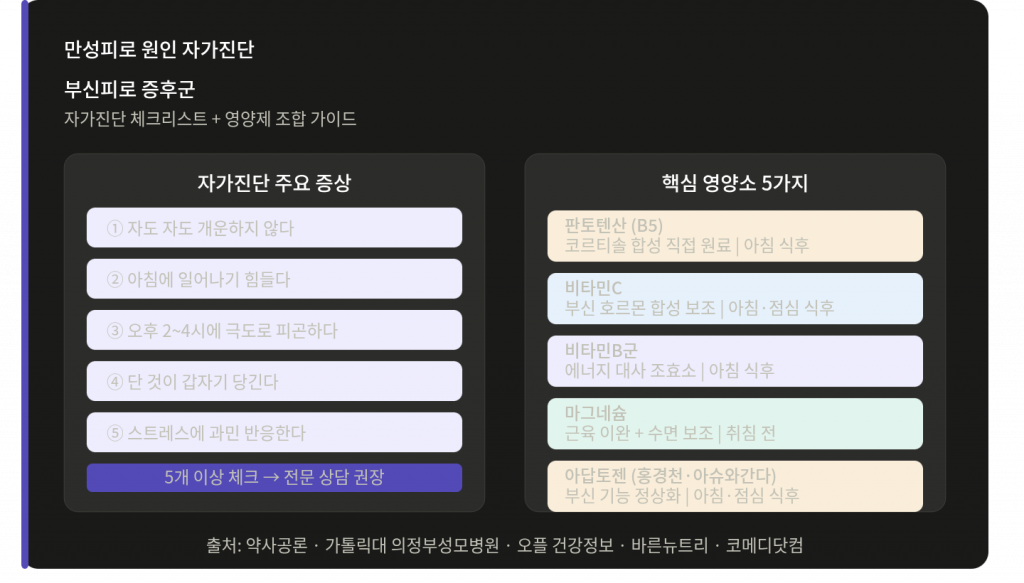
오늘은 부신피로 증후군 자가진단 체크리스트와 함께, 회복을 돕는 영양제 조합 가이드를 전문가 자료 기반으로 한 번에 정리해 드립니다.
2단계 — 저항(Resistance): 스트레스가 만성화되면 부신은 코르티솔을 지속적으로 분비하기 위해 과부하 상태에 놓입니다. 이 시기에 피로가 심해지고 면역력이 떨어지기 시작합니다.
3단계 — 고갈(Exhaustion): 지속적인 스트레스로 코르티솔 분비 능력이 한계에 도달하면 부신이 제대로 기능하지 못하는 부신피로 상태가 됩니다. (출처: 바른뉴트리 건강정보)
부신피로를 악화시키는 주요 원인
과도한 업무 스트레스와 야근, 수면 부족, 과도한 카페인 섭취, 정제 탄수화물과 설탕 위주 식단, 운동 부족 또는 과도한 운동, 인간관계 갈등과 정서적 스트레스, 소화 기능 저하와 장 건강 악화가 부신피로를 악화시키는 대표적인 원인으로 알려져 있습니다. (출처: 오플 건강정보, 바른뉴트리 건강정보)
부신피로 증후군 영양제 조합 가이드
핵심 영양소 1. 판토텐산(비타민B5) — 코르티솔 합성의 직접 원료
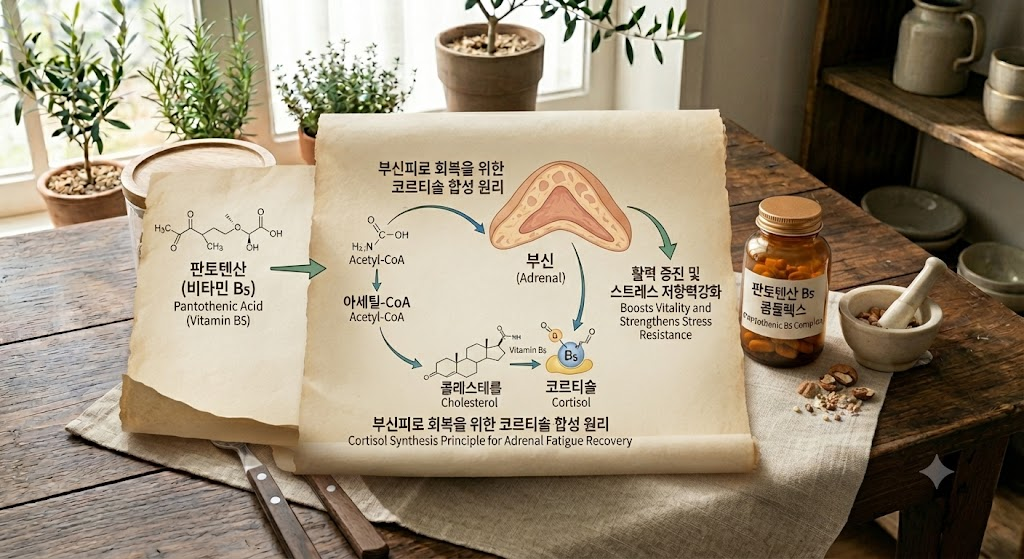
판토텐산은 부신피로 증후군 회복의 가장 핵심적인 영양소입니다. 판토텐산이 부족한 경우에 부신의 코르티솔 함량과 혈장 코르티솔 농도 저하가 발생하는데, 이는 부신 기능의 저하를 의미합니다. (출처: 약사공론)
몸에 흡수된 판토텐산은 대사 과정을 거쳐 아세틸코에이(Acetyl-CoA)로 변환되고, 이 물질이 콜레스테롤을 만나면 코르티솔이 합성됩니다. 즉 판토텐산은 코르티솔 생산의 직접적인 원료 역할을 합니다. (출처: 오플 건강정보)
권장 섭취량: 건강한 일반인의 하루 최적 섭취량은 100mg이지만, 부신피로 증후군 상태에서는 하루 1,500mg까지 섭취를 권장하는 전문가 의견도 있습니다. (출처: 오플 건강정보) 다만 고용량 섭취 전에는 반드시 의사·약사와 상담하시기 바랍니다.
복용 타이밍: 아침 식사 후 복용이 가장 효과적입니다.
핵심 영양소 2. 비타민C — 부신이 가장 많이 필요로 하는 비타민
비타민C는 부신피로 회복에서 판토텐산과 함께 가장 중요한 영양소입니다. 부신은 신체에서 비타민C의 함량이 가장 높은 기관 중의 하나이며, 비타민C는 부신에서 카테콜아민과 스테로이드 호르몬 합성에 필요한 코팩터(cofactor)로 작용합니다. (출처: 약사공론)
스트레스가 심해질수록 부신은 코르티솔을 만들기 위해 비타민C를 빠르게 소모합니다. 만성 스트레스 상태에서 비타민C가 결핍되면 부신의 호르몬 합성 능력이 더욱 저하되는 악순환이 발생합니다.
권장 섭취량: 부신피로 회복을 목적으로 할 경우 하루 1,000~3,000mg이 일반적으로 권장됩니다. 고용량 비타민C는 위장 자극이 있을 수 있으므로 식사 후 나눠서 복용하시는 것이 좋습니다.
복용 타이밍: 아침·점심 식사 후 나눠서 복용하는 것이 흡수율에 유리합니다.
핵심 영양소 3. 비타민B군 — 에너지 대사와 신경 안정의 조효소
판토텐산(B5)이 원활하게 작용하려면 다른 비타민B군이 반드시 필요합니다. 부신피로 증후군은 인슐린 저항성으로 에너지가 포도당으로 제대로 전환되지 않아 피로를 더 느끼게 되는데, 단백질이나 지방을 에너지로 사용할 때도 비타민B군이 조효소로서 반드시 필요합니다. (출처: 오플 건강정보)
특히 **비타민B3(나이아신)**은 부신피로 저하형(결핍형)에게 보통 사람의 3배 정도 고용량이 필요하다는 전문가 의견도 있습니다. (출처: Dr.PNT, 기능의학 전문 자료) 다만 고용량 나이아신은 홍조 등의 부작용이 있을 수 있으므로 반드시 전문가 지도 하에 섭취해야 합니다.
복용 타이밍: 비타민B군은 에너지 대사를 촉진하므로 아침 식사 후 복용하는 것이 가장 효과적입니다. 밤에 복용하면 수면에 방해가 될 수 있습니다.
핵심 영양소 4. 마그네슘 — 부신 기능 회복과 수면 보조
마그네슘은 비타민C, 아연과 함께 부신 기능 회복을 돕는 성분으로, 부신피로 증상 완화에 도움이 됩니다. (출처: 오플 건강정보) 특히 만성 스트레스 상태에서는 마그네슘이 빠르게 소모되는데, 마그네슘이 부족하면 신경계 과민, 근육 긴장, 불면증이 악화되는 악순환이 발생합니다.
홍경천·마그네슘·L-테아닌·비타민D가 이상적으로 배합된 조합은 극심한 스트레스와 이로 인한 피로를 개선하는 활성이 뛰어난 것으로 알려져 있습니다. (출처: 바른뉴트리 건강정보)
복용 타이밍: 취침 전 복용이 가장 효과적입니다. 근육 이완과 수면 보조 효과를 동시에 얻을 수 있습니다.
주의사항: 칼슘과 마그네슘은 흡수 경로가 겹치므로 동시에 복용하면 흡수율이 저하될 수 있습니다. 시간 간격을 두고 복용하시기 바랍니다.
핵심 영양소 5. 아답토젠 — 부신 기능을 정상으로 끌어올리는 허브
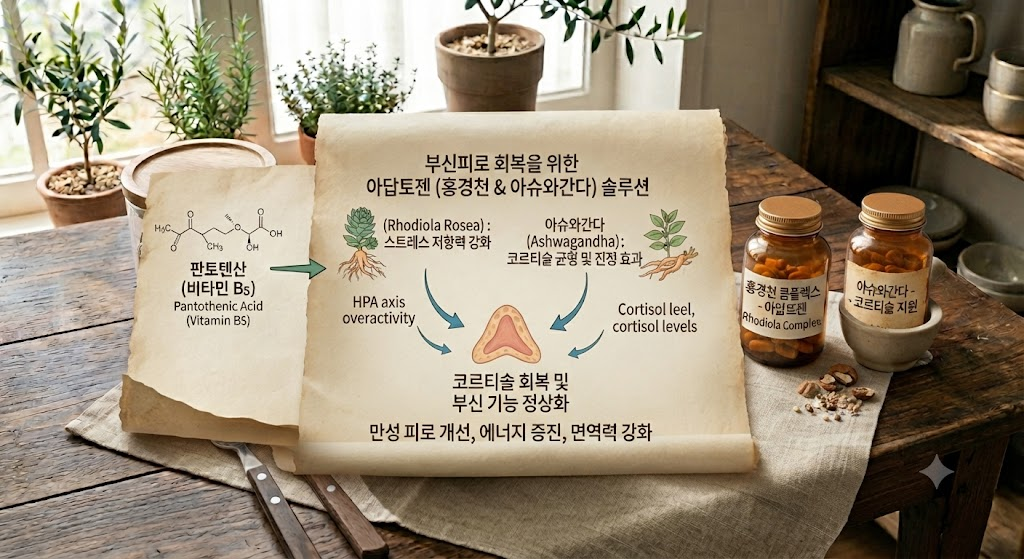
**아답토젠(Adaptogen)**은 고대 인도 아유르베다 의학에서부터 특효로 사용되어 온 허브 성분입니다. 저하된 부신 기능을 다시 정상으로 끌어올리는 역할을 하며 코르티솔의 생성과 분비를 돕습니다. 또한 부신 합성을 증가시키거나 부신이 비활성화되는 것을 막아서 부신을 오래 쓸 수 있게 만들어줍니다. (출처: Dr.PNT 기능의학)
대표적인 아답토젠 식물로는 홍경천(로디올라), 아슈와간다, 인삼·홍삼, 가시오가피, 황기, 감초, 홀리바질, 마카 등이 있습니다. (출처: 오플 건강정보)
특히 **홍경천(Rhodiola rosea)**은 스트레스 호르몬인 코르티솔 수준을 적절하게 조절하면서 피로를 줄이고 집중력을 높이는 효과가 있다고 알려져 있습니다. 판토텐산과 함께 섭취하면 시너지 효과를 낼 수 있습니다. (출처: 오플 건강정보)
복용 타이밍: 아답토젠은 일반적으로 아침 또는 점심 식사 후 복용이 권장됩니다. 일부 아답토젠은 각성 효과가 있어 저녁 복용 시 수면에 방해가 될 수 있습니다.
핵심 영양소 6. 비타민E + 아연 — 부신 호르몬 생성 보조
비타민E는 부신에서 스테로이드 호르몬 생성에 중요한 역할을 합니다. 비타민E가 부족한 상태에서는 ACTH(부신피질자극호르몬) 자극에 의한 코르티코스테론의 합성과 분비가 현저하게 줄어드는 것으로 확인됐습니다. (출처: 약사공론)
아연은 비타민C·마그네슘과 함께 부신 기능 회복을 돕는 3대 미네랄 중 하나입니다. (출처: 오플 건강정보) 다만 아연은 과잉 섭취 시 구리 결핍을 유발할 수 있으므로 권장량 범위 내에서 섭취하는 것이 중요합니다.
부신피로 증후군 영양제 조합 시간표 — 한눈에 정리
복용 시간
영양소
이유
아침 식사 후
판토텐산(B5) + 비타민B군 + 아답토젠
에너지 대사 활성화, 코르티솔 합성 지원
점심 식사 후
비타민C (1,000mg) + 비타민E + 아연
부신 호르몬 합성 코팩터 보충
저녁 식사 후
비타민C (나머지 용량)
하루 총 섭취량 분산 흡수
취침 전
마그네슘 + L-테아닌
근육 이완, 신경 안정, 수면 보조
(출처: 약사공론, 오플 건강정보, 바른뉴트리 건강정보, Dr.PNT 기능의학 종합)
부신피로 회복을 위한 생활습관 교정
영양소 보충만큼 중요한 것이 생활습관 교정입니다. 부신피로 증후군은 질병이 아닌 증후군에 속하나 질병으로 발전될 수 있는 가능성이 높은 상태이기 때문에 생활습관 교정 및 증상 개선에 좋은 영양제 섭취 등에 대한 관리가 필요합니다. (출처: 바른뉴트리 건강정보)
수면 우선: 코르티솔은 오전 8시 전후 가장 높게 분비되고 밤에는 낮아지는 일주기 리듬을 가집니다. 규칙적인 수면 시간을 지키는 것이 부신 기능 회복의 가장 기본입니다.
혈당 안정: 부신피로 증후군은 인슐린 저항성과 깊이 연결되어 있습니다. 정제 탄수화물과 단순당을 줄이고 복합 탄수화물, 단백질, 건강한 지방을 균형 있게 섭취하는 것이 중요합니다.
카페인 조절: 카페인은 코르티솔 분비를 자극해 단기적으로는 각성 효과를 주지만, 장기적으로는 부신을 더 혹사시킵니다. 오전에만 1~2잔으로 제한하는 것이 권장됩니다.
과도한 운동 피하기: 고강도 운동은 오히려 코르티솔을 더 소모시킵니다. 부신피로 상태에서는 가벼운 산책, 요가, 스트레칭 수준의 운동이 적합합니다.
A. 부신피로 증후군은 공식적인 의학적 진단명이 아니기 때문에 일반 혈액 검사로는 확인이 어렵습니다. 기능의학(Functional Medicine)을 전문으로 하는 의료기관에서는 타액 호르몬 검사(하루 4회 시간대별 코르티솔·DHEA 측정)나 동공 반사 검사 등을 통해 부신 기능 상태를 평가합니다. (출처: 바른뉴트리 건강정보)
Q2. 판토텐산 고용량(1,500mg)을 먹어도 안전한가요?
A. 전문가들이 부신피로 증후군 개선을 위해 고용량 섭취를 권장하는 경우가 있지만, 고용량 영양소 섭취는 반드시 의사·약사와 상담 후 진행하시는 것이 안전합니다. 현재 복용 중인 약이 있거나 기저질환이 있는 경우에는 특히 주의가 필요합니다.
Q3. 아답토젠 중 어떤 것이 가장 효과적인가요?
A. 아답토젠 종류마다 작용하는 방식이 조금씩 다릅니다. 홍경천(로디올라)은 스트레스와 피로 개선에, 아슈와간다는 코르티솔 수치 안정화에, 인삼·홍삼은 에너지 충전과 부신 기능 강화에 각각 특화된 것으로 알려져 있습니다. 한 가지를 선택하기보다 복합 제품을 활용하거나 증상에 맞게 전문가와 상담 후 선택하시는 것이 좋습니다. (출처: Dr.PNT 기능의학, 오플 건강정보)
Q4. 부신피로 회복에는 얼마나 걸리나요?
A. 부신피로의 정도에 따라 다르지만, 경미한 경우 1~2개월, 중등도 이상이면 6개월~1년 이상의 꾸준한 관리가 필요합니다. 영양소 보충과 생활습관 교정을 동시에 진행할 때 회복이 빨라집니다.
Q5. 자가진단 점수가 8개 이상이라면 어디에 가야 하나요?
A. 기능의학을 전문으로 하는 내과·가정의학과를 방문하시거나, 통합의학 클리닉을 찾아보시는 것을 권장드립니다. 스스로 진단하고 고용량 영양제를 무작정 복용하기보다, 전문가의 평가를 통해 본인에게 맞는 영양요법을 처방받는 것이 가장 안전하고 효과적입니다.
자고 일어나도 개운하지 않은 피로, 이제 단순히 “피곤해서 그렇겠지”라고 넘기지 마세요.
오늘 소개한 자가진단 체크리스트로 내 상태를 먼저 파악하고, 판토텐산·비타민C·마그네슘·아답토젠이라는 핵심 영양소 조합으로 지친 부신에게 회복할 기회를 주세요. 다만 자가진단 결과가 높게 나왔다면, 영양제보다 먼저 전문 의료기관 상담을 최우선으로 권장드립니다.
Have you ever searched for slow aging diet reviews, found nothing but flawless success stories, and quietly closed the tab thinking “there’s no way I could do that”? This post is written for you.
I’m a 37-year-old office worker based in Seoul. Overtime at least three nights a week is just the baseline, and after-work dinners are a regular part of the job. At my last health checkup, my fasting blood glucose was flagging at 104mg/dL — right at the borderline.
Every afternoon around 2 PM, I’d hit a wall of post-lunch drowsiness so severe that I couldn’t get through the afternoon without coffee. My weight had crept up 8kg since I first joined the workforce. Every morning in front of the mirror, I’d think: “When did this happen?”
The reason I started a slow aging diet as a 30-something office worker wasn’t dramatic. It was one sentence from Dr. Jeong Hee-won, Professor of Geriatric Medicine at Asan Medical Center, that stuck with me: “Today’s people in their 30s and 40s may age faster than their parents’ generation.” (Source: KB Financial Health Information, Dr. Jeong Hee-won Seminar)
That landed. So I made a decision: just 3 months, done properly.
Today I’m sharing an honest slow aging diet 3-month review — including the moments I failed. Here are the real numbers showing how my weight, fatigue, and blood sugar actually changed.
My doctor had looked at my checkup results and told me my eating habits needed to change. But I had no idea where to actually start. The reason I chose the slow aging diet came down to one thing: I didn’t have to starve. Rather than counting calories or completely cutting out specific foods, the approach was about swapping intelligently — and that felt realistic for my life.
Month 1 — Excitement and Frustration at the Same Time
What I changed
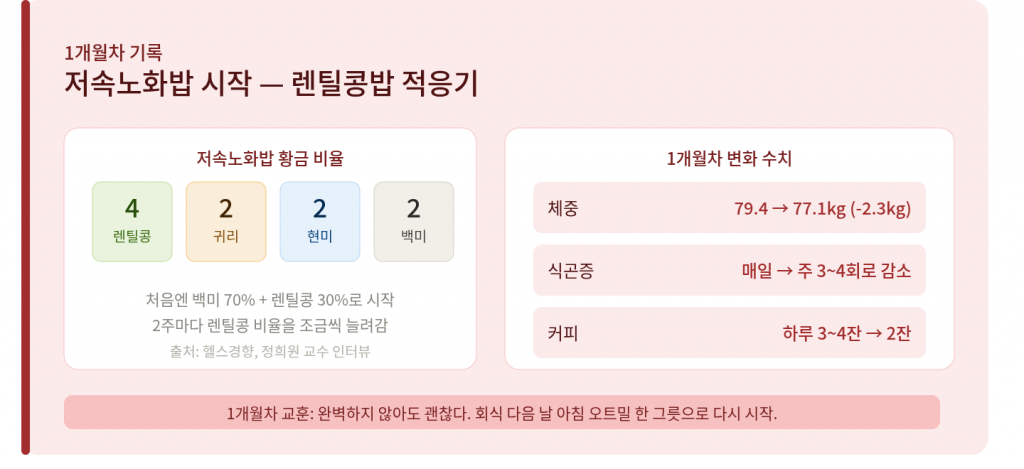
The first shift in the slow aging diet was changing the rice itself. I started cooking rice using Dr. Jeong Hee-won’s recommended grain ratio: lentils : oats : brown rice : white rice = 4 : 2 : 2 : 2. (Source: Health Kyunghyang, Dr. Jeong Hee-won Interview) In the first two weeks, I genuinely struggled with the smell and the denser texture of lentil rice. Honestly? I wanted to quit at least three times.
I also cut out sugary drinks and fruit juice, replacing them with water and unsweetened green tea. Carbonated drinks, fruit juices, cereals, white bread, and white rice all spike blood sugar sharply, triggering insulin secretion and sending energy toward fat storage and the liver rather than muscle — one of the main drivers of accelerated aging. (Source: KB Financial Health Information)
Month 1 failure log
Two after-work dinners. One late-night fried chicken after overtime. Three cups of instant noodles from the convenience store. It was far from perfect.
At one dinner, sitting across from colleagues eating pork belly and soju, I felt the familiar thought: “This week is ruined.” And looking back, that feeling of defeat did more damage than the actual food. Once I “broke,” I’d slip into “well, today’s gone anyway” thinking and abandon the next meal too.
Month 1 lesson: Imperfection is fine. Coming back to an oatmeal breakfast the morning after a dinner out is more than enough to get back on track.
Month 1 results
Metric
After Month 1
Change
Weight
77.1kg
-2.3kg
Post-lunch crash
Down to 3–4 times/week
Improving
Coffee
Average 2 cups/day
-1 cup
A word of caution on that early weight drop: cutting simple carbohydrates causes glycogen to break down within 1–2 weeks, which reduces water retention and often shows a 3–4kg drop on the scale.
Research comparing different dietary patterns at the 3-month mark found that participants who most consistently cut refined grains achieved and maintained the greatest reductions in added sugars and refined carbohydrates. Some of that initial drop was water weight — I knew that going in.
Month 2 — When Things Actually Started to Change
The first real shift — the energy crash disappeared
Quietly, at the start of week 4 of month 2, something changed. I was in a 2 PM meeting and suddenly realized: “Wait. I’m not falling asleep.” I assumed it was a coincidence. But the next day was the same. And the day after that.
When blood sugar spikes are reduced through the slow aging diet, insulin doesn’t need to surge as dramatically — and without that sharp post-meal blood sugar drop, the afternoon energy crash naturally fades. Whole grain rice takes longer to digest and absorb, which raises blood sugar gradually and provides sustained energy. (Source: Medisola Slow Aging Diet Research)
A clinical study tracking fatigue levels over three months found that dietary changes were associated with significant decreases in both mental and physical fatigue scores — mental fatigue dropped from 10.3 to 8.4 on the Fatigue Assessment Scale, and fatigue severity dropped from 3.5 to 2.9 on the FSS. I wasn’t part of a clinical trial, but my experience tracked remarkably closely with findings like these.
The habit that made month 2 sustainable — weekend meal prep
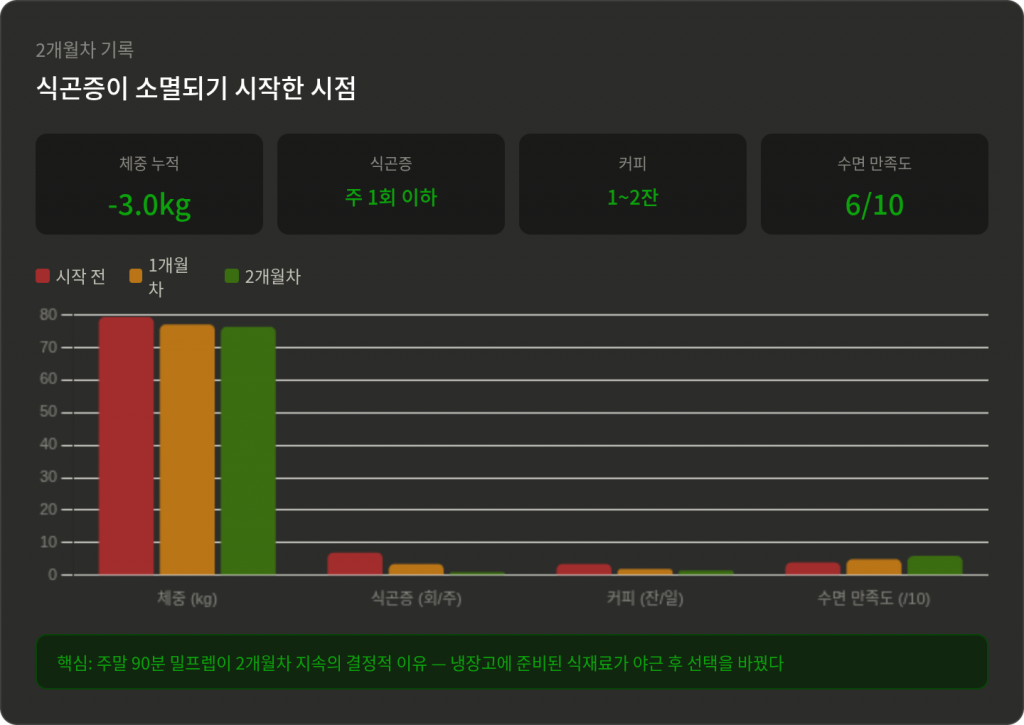
Starting weekend meal prep was the single most important change in month 2. I invested 90 minutes every Sunday to freeze slow aging rice in single-serve portions, boil 6 eggs, and pre-grill chicken breast. Knowing prepared food was waiting in the fridge meant that after late overtime, I could reach for a real meal instead of defaulting to convenience store food.
Month 2 results
Metric
After Month 2
Change
Weight
76.4kg
Cumulative -3.0kg
Post-lunch crash
Once a week or less
Nearly gone
Coffee
1–2 cups/day
Habitual dependency broken
Sleep satisfaction
6 out of 10
+2 points
Morning condition
Refreshed 3+ mornings/week
Noticeable improvement
Month 3 — Confirmed in Numbers
Health checkup results at the end of month 3
When month 3 ended, it was time for the company health checkup. I was nervous. I could feel the changes — but I wasn’t sure how much the numbers had actually moved. Here’s what the results showed:
Metric
Before
After 3 Months
Change
Weight
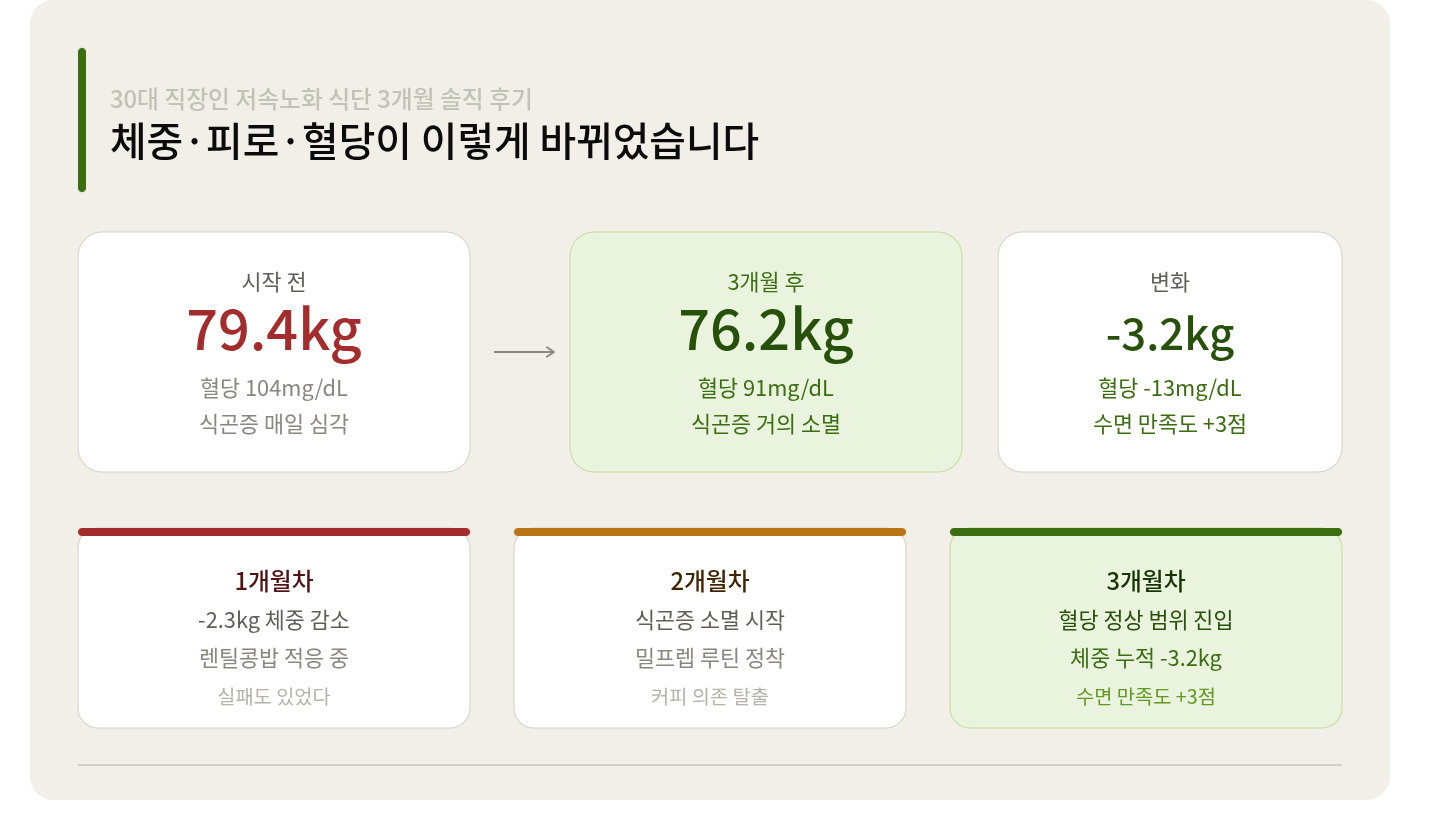
79.4kg
76.2kg
-3.2kg
Fasting blood glucose
104mg/dL
91mg/dL
-13mg/dL (entered normal range)
Post-lunch crash
Severe, daily
Virtually gone
Eliminated
Coffee dependency
3–4 cups/day
1 cup/day
-2 to 3 cups
Sleep satisfaction
4/10
7/10
+3 points
Morning condition
Fatigued 5 days/week
Fatigued 1–2 days/week
Dramatically improved
Research tracking patients with impaired fasting glucose over three months found that fasting blood glucose in the borderline group decreased from 108.49 to 101.8 mg/dL — a meaningful improvement that aligns with what dietary intervention can realistically achieve. My own drop from 104 to 91mg/dL reflected a similar pattern of dietary change combined with light exercise.
Beyond the numbers, the most tangible shift was in concentration. In afternoon meetings, I was no longer just surviving — I could actually focus. The slow aging diet is associated with improvements in brain fog, mood, concentration, and memory. (Source: Health Kyunghyang)
Month 3 honest limitations
Good stories deserve full disclosure.
Weeks with lots of dining out were genuinely hard. One week with three consecutive team dinners — I didn’t manage a single bowl of slow aging rice. During one business trip I survived entirely on convenience store food and restaurant meals. That week, the afternoon energy crash came back.
Maintaining the slow aging diet at 100% as an office worker who does regular overtime isn’t realistic. Dr. Jeong Hee-won says it clearly: “Sustaining 70% consistency over time is far more effective than chasing 100% perfection.” (Source: Dr. Jeong Hee-won, “You Can Age Slowly Too”) I stopped reading that as consolation and started treating it as strategy.
The 5 Practices That Made the Biggest Difference
Looking back over 3 months, the biggest changes didn’t come from special superfoods.
① Switching to slow aging rice (the single biggest impact)
The lentil : oat : brown rice : white rice = 4 : 2 : 2 : 2 blend had the most direct effect on post-meal blood sugar and afternoon fatigue of anything I tried.
② Replacing all drinks with water and unsweetened tea
Simply cutting sugary drinks and fruit juice noticeably reduced my daily sugar intake — no calorie counting required.
③ Vegetables first at every meal
Changing the order — vegetables → protein → carbohydrates — made a noticeable difference in how fast I felt the post-meal energy dip.
④ 90-minute Sunday meal prep
Prepared food in the fridge changed the choices I made after late overtime. It’s the most underrated habit of the entire 3 months.
⑤ Starting over from the very next meal after a failure
Not quitting when I slipped was the only reason I made it through all 3 months.
Who the Slow Aging Diet Is Right For
The slow aging diet works well for most healthy adults, but it isn’t one-size-fits-all. Whole oats and brown rice can be difficult to digest — if your digestion is sensitive, soak grains for at least 8 hours before cooking, or begin with white rice and a small amount of lentils, increasing the ratio gradually.
The diet may not be suitable for people who are frail, have sarcopenia, or have significant digestive issues. (Source: KB Financial Health Information) Anyone managing diabetes, kidney disease, or other chronic conditions should consult their healthcare provider before making significant dietary changes.
The checklist that kept me going — sharing it for anyone following along.
No.
Check Item
Check
1
Ate slow aging rice (lentils + oats + brown rice) today
☐
2
Replaced drinks with water or unsweetened green tea
☐
3
Started the meal with vegetables first
☐
4
Chose nuts or fruit as a snack
☐
5
Didn’t give up after an imperfect meal — started fresh at the next one
☐
6
Had less post-lunch drowsiness than yesterday
☐
7
Did weekend meal prep for the week ahead
☐
8
Cut off caffeine before 2 PM
☐
Share your score in the comments — I’d genuinely love to hear about your changes too.
Frequently Asked Questions (FAQ)
Q1. Can you actually lose weight on the slow aging diet in just 3 months?
A. Individual results vary significantly, but in my case I lost 3.2kg over 3 months. The slow aging diet isn’t designed for rapid weight loss — but reducing refined carbohydrates and processed foods naturally cuts unnecessary calorie intake. The early weeks often show faster drops as water retention decreases when glycogen is broken down. (Source: CEO & Partners Monthly)
Q2. I work overtime regularly too — how did you actually stick to this?
A. I had the exact same concern. The most effective solution by far was weekend meal prep. With frozen slow aging rice and pre-cooked protein waiting in the fridge, the choice after late overtime became much easier. Aim for 70% consistency — not perfection.
Q3. The smell of lentil rice is really off-putting. How did you get through it?
A. The first two weeks were the hardest. Soaking lentils for at least 8 hours before cooking significantly reduced the smell for me. Starting at 70% white rice and 30% lentils, then gradually shifting the ratio every 2–3 weeks, helps your palate adapt naturally. It actually happened faster than I expected.
Q4. Did your blood sugar really improve from diet alone?
A. My fasting blood glucose dropped from 104mg/dL to 91mg/dL over 3 months. I also added light evening walks (3+ times per week), so the improvement reflects both diet and movement working together. Clinical research has confirmed that dietary changes alone are associated with meaningful reductions in fasting blood glucose in people with borderline readings. If you’ve been diagnosed with diabetes, please manage your diet in consultation with your doctor.
Q5. Are you still maintaining it now, at month 4?
A. Yes — currently in month 4 and still going. Honestly, by the time 3 months are up, slow aging rice starts to feel normal. The moment “this actually tastes good” arrives. I still go to work dinners and don’t avoid eating out — but the habit of coming back to slow aging meals the next day is solid now.
The biggest thing I took from 3 months of slow aging eating wasn’t any single number.
It was the realization that what you eat changes the quality of your entire day. When you’re not drowsy after lunch, the hours after work actually exist. When mornings feel refreshed, the day starts differently. The slow aging diet is worth starting — even imperfectly.
저속노화 식단 후기, 찾아보셨다가 너무 완벽한 성공담만 나와서 “나는 저렇게 못 할 것 같은데”하고 닫으신 적 있으신가요? 이 글은 그런 분들을 위해 씁니다.
저는 서울에서 일하는 37세 직장인입니다. 야근은 주 3회 이상이 기본이고, 회식도 잦습니다. 건강검진에서 공복혈당 수치가 경계선(104mg/dL)에 걸렸고, 매일 오후 2시만 되면 쏟아지는 식곤증에 커피 없이는 오후를 버티기 어려웠습니다. 체중은 입사 때보다 8kg이 늘어있었고, 아침마다 거울 앞에서 “언제 이렇게 됐지”를 반복했습니다.
30대 직장인 저속노화 식단을 시작하게 된 건 거창한 이유가 아니었습니다. 정희원 서울아산병원 노년내과 교수가 “지금의 30~40세대가 부모 세대보다 더 빨리 늙을 것”이라고 한 말이 너무 와 닿아서, 딱 3개월만 제대로 해보자고 결심했습니다. (출처: KB금융 건강정보, 정희원 교수 세미나 발언)
오늘은 저속노화 3개월 후기를 실패했던 순간까지 포함해 정직하게 공유합니다. 체중, 피로, 혈당이 실제로 어떻게 바뀌었는지, 숫자로 보여드리겠습니다.
건강검진 결과지를 보며 의사에게 “식습관 개선이 필요하다”는 말을 들었지만, 뭘 어떻게 바꿔야 할지 막막했습니다. 저속노화 식단을 선택한 이유는 단 하나였습니다. 굶지 않아도 된다는 것. 칼로리를 계산하거나 특정 식품을 완전히 끊는 방식이 아니라, 먹는 것을 현명하게 바꾸는 접근 방식이 제 상황에 맞았습니다.
1개월차 — 기대와 좌절이 동시에
실천 내용
저속노화 식단의 첫 번째 변화는 밥을 바꾸는 것이었습니다. 정희원 교수가 추천하는 렌틸콩:귀리:현미:백미 = 4:2:2:2 비율로 밥을 짓기 시작했습니다. (출처: 헬스경향, 정희원 교수 인터뷰) 처음엔 렌틸콩 특유의 냄새와 퍽퍽한 식감에 적응이 힘들었습니다. 솔직히 말하면 첫 2주 동안 세 번은 포기하고 싶었습니다.
탄산음료와 과일주스를 물과 무가당 녹차로 바꾸는 것도 병행했습니다. 단순당과 정제 곡물이 잔뜩 들어간 탄산음료, 과일주스, 시리얼, 빵, 흰쌀밥은 혈당을 급격히 올려 인슐린 분비를 유발하고 에너지를 근육이 아닌 지방과 간에 쌓이게 만드는 주범입니다. (출처: KB금융 건강정보)
1개월차 실패 기록
회식 2번, 야근 후 치킨 1번, 편의점 컵라면 3번. 완벽하지 않았습니다.
회식 자리에서 삼겹살과 소주를 먹으면서 “이번 주는 망했다”는 생각을 했습니다. 그런데 돌이켜보면 그 순간의 패배감이 오히려 독이 됐습니다. 한 번 무너지면 “어차피 오늘은 망했으니까”라는 생각으로 다음 끼니까지 포기하게 되더군요.
1개월 차 교훈: 완벽하지 않아도 괜찮습니다. 회식 다음 날 아침을 오트밀로 시작하는 것만으로도 충분히 다시 궤도에 올라올 수 있습니다.
1개월 차 변화
항목
1개월 후
변화
체중
77.1kg
-2.3kg
식곤증
주 3~4회로 감소
개선 중
커피 의존도
하루 평균 2잔
1잔 감소
체중이 빠진 것은 식단 때문만이 아닐 수 있습니다. 단순 탄수화물을 줄이면 1~2주 이내에 체내 글리코겐이 분해되면서 부종이 개선되고 체중이 3~4kg 줄어드는 경우가 많습니다. (출처: 월간 CEO& 파트너스) 초반 체중 감소의 일부는 수분 감소일 수 있다는 점을 인지하고 있었습니다.
2개월차 — 몸이 진짜로 달라지기 시작한 시점
가장 먼저 느낀 변화 — 식곤증 소멸
2개월 차 4주째, 아주 조용하게 변화가 찾아왔습니다. 오후 2시 회의 중에 갑자기 깨달았습니다. “어? 오늘 안 졸리네.” 처음엔 우연인 줄 알았는데, 다음 날도, 그다음 날도 같았습니다.
저속노화 식단으로 혈당 스파이크가 줄어들자 인슐린이 과도하게 분비되지 않게 되고, 식후 급격한 혈당 하강이 사라지면서 식곤증이 자연스럽게 개선된 것입니다. 통곡물로 구성된 밥은 소화 흡수 시간이 느려 혈당을 천천히 올려주고 지속적인 에너지를 공급합니다. (출처: 메디쏠라 저속노화 식단 연구)
2개월 차 루틴 정착
주말 밀프렙을 시작한 것이 2개월 차 지속의 핵심이었습니다. 일요일 오후 90분을 투자해 저속노화밥을 1인분씩 냉동하고, 삶은 달걀 6개, 닭가슴살을 미리 구워두었습니다. 냉장고에 식재료가 준비되어 있으니 야근 후에도 편의점 대신 집에서 간단하게 챙겨 먹을 수 있었습니다.
2개월 차 변화
항목
2개월 후
변화
체중
76.4kg
누적 -3.0kg
식곤증
주 1회 이하
거의 소멸
커피 의존도
하루 평균 1~2잔
습관적 의존 탈출
수면 만족도
10점 중 6점
+2점 상승
아침 컨디션
주 3회 이상 개운함
뚜렷한 개선
3개월차 — 숫자로 확인한 변화
3개월 후 건강검진 결과
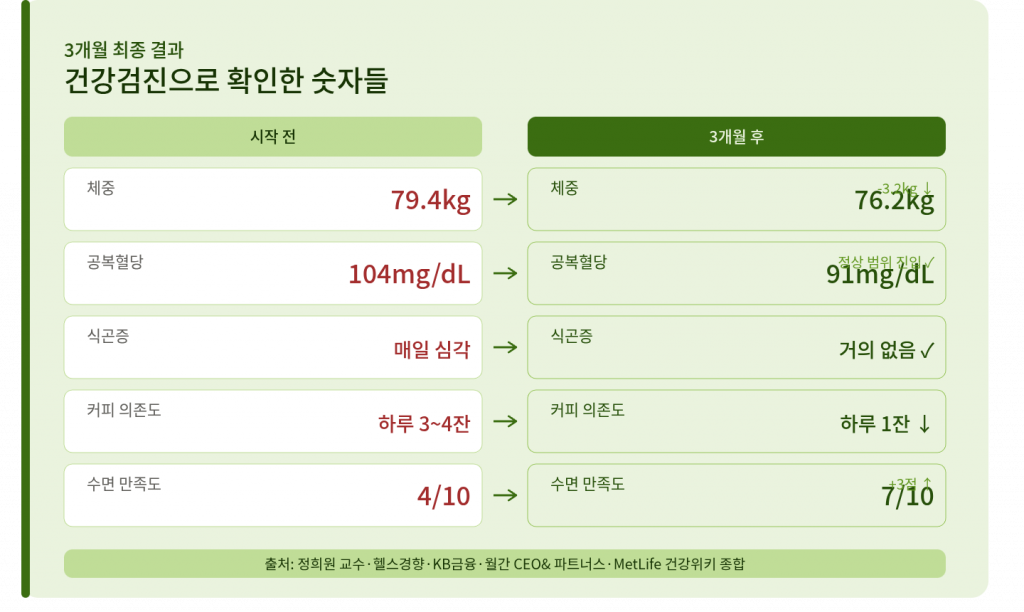
3개월 차가 끝날 무렵 회사 건강검진이 있었습니다. 솔직히 긴장했습니다. 식단이 많이 달라졌다고 느꼈지만, 수치가 실제로 얼마나 바뀌었을지 확신이 없었으니까요. 결과는 다음과 같았습니다.
항목
시작 전
3개월 후
변화
체중
79.4kg
76.2kg
-3.2kg
공복혈당
104mg/dL
91mg/dL
-13mg/dL (정상 범위 진입)
식곤증
매일 심각
거의 없음
소멸
커피 의존도
하루 3~4잔
하루 1잔
-2~3잔
수면 만족도
10점 중 4점
10점 중 7점
+3점
아침 컨디션
주 5일 피로
주 1~2일 피로
대폭 개선
저속노화 식단은 브레인포그, 우울감, 집중력 저하, 건망증, 부기, 염증 등을 개선하는 효과가 있다고 알려져 있습니다. (출처: 헬스경향)수치보다 일상에서의 변화가 더 크게 느껴진 것은 집중력이었습니다. 오후 회의에서 예전처럼 버티는 것이 아니라 실제로 집중할 수 있게 됐습니다.
3개월 차 솔직한 한계
좋은 것만 말하는 것은 정직하지 않습니다.
외식이 많은 주는 식단 유지가 정말 힘들었습니다. 팀 회식 3연속이었던 한 주는 저속노화밥을 단 한 번도 못 먹었습니다. 출장 기간에는 편의점과 식당 밥으로만 때워야 했고, 그 주에는 식곤증이 다시 살아났습니다.
완벽한 저속노화 식단을 100% 지키는 것은 야근하는 직장인에게 현실적으로 어렵습니다. 정희원 교수도 “100% 완벽한 저속노화 식단보다 70% 수준을 꾸준히 유지하는 것이 훨씬 효과적”이라고 강조합니다. (출처: 정희원 교수 저서 ‘당신도 느리게 나이 들 수 있습니다’)저는 이 말을 위안이 아니라 전략으로 받아들였습니다.
3개월 동안 가장 효과적이었던 실천 5가지
3개월을 돌아봤을 때, 가장 변화를 만들어낸 것은 화려한 식재료가 아니었습니다.
① 저속노화밥으로 바꾸기 (가장 큰 변화)
렌틸콩:귀리:현미:백미 = 4:2:2:2 비율의 잡곡밥 하나가 식후 혈당과 식곤증에 가장 직접적인 영향을 미쳤습니다.
② 음료수를 물·녹차로 교체
탄산음료와 과일주스를 끊는 것만으로도 하루 당분 섭취가 눈에 띄게 줄었습니다.
③ 채소 먼저 먹기
식사 순서를 채소 → 단백질 → 탄수화물 순으로 바꾸는 것만으로도 식후 혈당 상승 속도가 달라지는 것을 체감했습니다.
④ 주말 90분 밀프렙
냉장고에 준비된 식재료가 있는 것이 평일 야근 후의 선택을 바꿨습니다.
⑤ 실패해도 다음 끼니부터 다시 시작
한 번 무너졌다고 포기하지 않는 것이 3개월을 완주하게 만든 핵심이었습니다.
저속노화 식단, 이런 분께 추천합니다
저속노화 식단은 대부분의 건강한 성인에게 효과적이지만, 모든 분께 동일하게 맞는 것은 아닙니다. 통귀리나 통현미는 소화가 어려울 수 있어, 소화력이 약하다면 귀리나 현미를 24시간 불린 뒤 밥을 짓거나 백미에 렌틸콩을 조금씩 넣어가며 점차 적응하는 것이 좋습니다. (출처: KB금융 건강정보)
당뇨나 신장 질환 등 기저질환이 있는 경우에는 반드시 담당 의료진과 상담 후 실천하시기 바랍니다.
A. 개인차가 크지만, 제 경우 3개월 동안 3.2kg이 빠졌습니다. 저속노화 식단은 다이어트가 목적이 아니지만, 정제 탄수화물과 단순당을 줄이면 자연스럽게 체중이 안정되는 경우가 많습니다. 특히 1개월 차에 부종이 빠지면서 초반 감소가 빠르게 느껴질 수 있습니다. (출처: 월간 CEO& 파트너스)
Q2. 야근이 많아서 저속노화 식단을 지키기 힘든데, 어떻게 했나요?
A. 저도 같은 고민이었습니다. 가장 효과적이었던 방법은 주말 밀프렙입니다. 냉동해둔 저속노화밥이 냉장고에 있으면, 야근 후에도 편의점 대신 집에서 간단히 해결할 수 있었습니다. 완벽하지 않아도 됩니다. 70% 유지를 목표로 삼으세요.
Q3. 렌틸콩밥 냄새가 너무 싫은데 어떻게 극복했나요?
A. 처음 2주가 가장 힘들었습니다. 저는 렌틸콩을 8시간 이상 물에 불린 뒤 밥을 지으니 냄새가 많이 줄었습니다. 처음엔 백미 70% + 렌틸콩 30%로 시작해 2~3주마다 렌틸콩 비율을 조금씩 높여갔습니다. 입맛은 생각보다 빨리 적응됩니다.
Q4. 혈당 수치가 실제로 낮아졌나요? 식단만으로 가능한가요?
A. 저는 3개월 만에 공복혈당이 104mg/dL에서 91mg/dL로 낮아졌습니다. 다만 식단 외에 저녁 산책(주 3회 이상)도 병행했습니다. 식단과 운동이 함께 작용한 결과로 보고 있으며, 이미 당뇨 진단을 받으신 분들은 반드시 의료진과 상담 후 관리하시길 권장드립니다.
Q5. 3개월 이후에도 계속 유지하고 있나요?
A. 네, 4개월째 현재도 유지 중입니다. 사실 3개월이 지나면 저속노화밥이 자연스러워집니다. “이게 더 맛있다”는 생각이 드는 순간이 오더군요. 외식이나 회식은 완벽하게 피하지 않고, 다음 끼니를 저속노화 식단으로 돌아오는 방식으로 계속 유지하고 있습니다.
3개월의 기록을 마무리하면서 가장 크게 느낀 것은 식단이 몸뿐 아니라 하루의 질을 바꾼다는 것입니다.
오후가 졸리지 않으면, 퇴근 후 저녁 시간이 생깁니다. 아침이 개운하면, 하루를 시작하는 에너지가 달라집니다. 저속노화 식단 3개월, 완벽하지 않아도 시작할 가치가 있습니다.
Fatigue recovery after late-night work — are you actually doing it right? It’s 11 PM and you’ve finally shut down your computer, but your body feels like lead. Tomorrow morning you’ll drag yourself back to the office feeling just as drained as you do right now. If you work overtime regularly, this cycle is all too familiar.
The problem is that reaching for another coffee or simply pushing through does nothing for real fatigue recovery. What your body actually needs after late-night work isn’t more stimulation — it’s timely replenishment of the fatigue recovery nutrients that have been depleted.
When the liver’s detoxification function is impaired, fatigue-causing substances accumulate in the body. When energy metabolism in the liver isn’t working efficiently, the body can’t produce the energy needed for daily activity — and vitality drops. (Source: Pillyze Pharmacist & Dietitian Guide)
Today, we break down the 5 fatigue recovery nutrients you should take tonight after late-night work — with pharmacist-backed guidance on effects, timing, and precautions all in one place.
What’s Actually Happening in Your Body During Late-Night Work?
Overtime isn’t just about losing sleep. During prolonged late-night work, the nutrients needed for energy metabolism are rapidly depleted, lactic acid — a fatigue-causing compound — accumulates in the liver, and cortisol (the stress hormone) is oversecreted, degrading sleep quality even further.
Quality sleep is essential for physical recovery and energy restoration, and when sleep quality deteriorates, fatigue accumulates and begins to interfere with daily functioning. (Source: Pillyze Pharmacist & Dietitian Guide)
Breaking this cycle is precisely what fatigue recovery nutrients are designed to do — when taken at the right time.
Fatigue Recovery Nutrient 1. Vitamin B Complex – The Engine of Energy Metabolism
The first fatigue recovery nutrient to reach for after late-night work is undeniably the vitamin B complex. Stress depletes B vitamins, alcohol blocks absorption, and highly processed foods strip them out — making deficiency surprisingly common, especially in B12, B6, and folate. (Source: Wellbeing Nutrition)
B-complex vitamins play a crucial role in energy metabolism and nervous system function. They help convert food into energy and support normal brain activity, which is especially important during periods of prolonged stress. (Source: NAT B Health Guide)
In particular, vitamin B1 (thiamine) and B2 (riboflavin) protect liver cells and help eliminate lactic acid — the main fatigue-causing substance that builds up in the body during overtime. (Source: Hidoc, Pharmacist Hyun Go-eun) Because B vitamins work as interlocking cofactors in the energy production chain, all of them need to be present for cells to function properly. (Source: Pillyze Pharmacist & Dietitian Guide)
When to take it: Unless your practitioner specifically advises otherwise, nighttime supplementation works against your circadian rhythm — think daylight, not moonlight. (Source: Wellbeing Nutrition)Take vitamin B complex after breakfast for optimal effect.
Precaution: High-dose activated B vitamins are classified as over-the-counter medications in Korea and require pharmacy purchase. Consult a pharmacist to find the right product for your needs. (Source: Pillyze Pharmacist & Dietitian Guide)
Fatigue Recovery Nutrient 2. Magnesium – Muscle Relaxation and Deep Sleep Together
Magnesium is an indispensable fatigue recovery nutrient for unwinding the tension that builds up during late-night work. Magnesium is a mineral essential for energy production, muscle contraction, nerve transmission, and blood pressure regulation. (Source: Pilly Health Information) It also has a relaxation function that calms the body and mind, making it a natural sleep support. (Source: LG U+ Health Magazine)
Beyond sleep, magnesium helps relax muscles and relieve pain — making it particularly effective for recovering from the tight, aching shoulders and neck that come from hours at a desk. (Source: Pilly Health Information)
When to take it: Taking magnesium before bed is most effective. You get the muscle relaxation and sleep support benefits simultaneously. (Source: LG U+ Health Magazine)
Precaution: Magnesium may interact with certain antibiotics and osteoporosis medications, and excessive intake can cause gastrointestinal discomfort. Stick to the recommended daily amounts (adult men: 400–420mg, adult women: 310–320mg). If you’re also taking calcium, take the two at different times — calcium and magnesium compete for absorption and taking them together reduces the effectiveness of both. (Source: LG U+ Health Magazine, Pilly Health Information)
Fatigue Recovery Nutrient 3. Coenzyme Q10 – Recharging Energy at the Cellular Level
Coenzyme Q10 plays a central role in cellular energy production. It supports mitochondrial function inside cells to boost energy output, while also acting as a potent antioxidant. (Source: Pilly Health Information) It’s one of the most well-established fatigue recovery nutrients for supporting energy generation, metabolic activity, and antioxidant protection. (Source: Dr. Now Pharmacist Consultation)
From around age 40, the body’s natural synthesis of CoQ10 begins to decline noticeably — making it especially important for middle-aged professionals who work overtime frequently. Many fatigue recovery supplement formulas combine UDCA, amino acids, and CoQ10 specifically for their combined energy-generating benefit. (Source: Pillyze Pharmacist & Dietitian Guide)
When to take it: CoQ10 is fat-soluble, so absorption is significantly higher when taken with food. Take it after breakfast or lunch.
Precaution: CoQ10 may interact with certain blood pressure medications. If you’re on antihypertensives, consult your doctor before starting. The recommended daily dose is 100–200mg. (Source: Pilly Health Information)
Fatigue Recovery Nutrient 4. UDCA & Milk Thistle – Clearing Liver Fatigue at the Source
On nights when overtime and after-work drinks collide, liver health needs to be on your radar too. UDCA supports the liver’s detoxification process to enhance its cleansing effect and aids in the regeneration of liver cells — when energy metabolism normalizes as a result, fatigue levels improve. (Source: Pillyze Pharmacist & Dietitian Guide)
UDCA and milk thistle work through different mechanisms in the liver, making them complementary rather than redundant. Where UDCA clears waste products by flushing out toxins, milk thistle’s high antioxidant activity neutralizes the free radicals that can damage liver cells — acting as a protective shield for hepatocytes.
Because they work through distinct pathways in the liver, it’s perfectly fine to take both together. (Source: Hidoc, Pharmacist Hyun Go-eun)Arginine supports blood circulation while also contributing to fatigue recovery, making it a good complement to liver supplements when taken together. (Source: Hidoc, Pharmacist Oh Jeong-seok)
When to take it: UDCA is most effective when taken with or immediately after a meal. This aligns with the peak bile secretion period post-meal, optimizing drug absorption. The active compound in milk thistle — silymarin — has a standard dose of 130mg per day, best divided into 2–3 doses. (Source: Pillyze Pharmacist & Dietitian Guide, Hidoc)
Precaution: When selecting a milk thistle product, look for one certified to international GACP standards from seed cultivation through extraction. Always check the silymarin content on the label — not just the total milk thistle amount listed. (Source: Hidoc)
Fatigue Recovery Nutrient 5. Arginine & Taurine – Circulation Boost and Energy Recharge
Arginine and taurine are the core ingredients in most fatigue recovery drinks — and for good reason. Taurine works through mechanisms similar to arginine to improve blood circulation, and research has shown a synergistic effect when the two are taken together. (Source: Pillyze Pharmacist & Dietitian Guide)
High-dose arginine products are among the most commonly recommended options for people with particularly demanding days of overtime, and combining arginine with ornithine and citrulline effectively increases nitric oxide production — amplifying the vasodilating effect. (Source: Pillyze Pharmacist & Dietitian Guide, Pharmacist Kang Yeo-wool)
When to take it: Take before or after dinner on days when you anticipate late-night work — it supports circulation and helps maintain energy levels through the evening.
Precaution: For individuals with underlying conditions or currently taking prescription medications, the appropriate type and dosage of supplements may vary. Always consult a doctor or pharmacist for guidance tailored to your specific situation. (Source: Dr. Now Pharmacist Consultation)
Fatigue Recovery Supplement Timing — At a Glance
Nutrient
Best Time to Take
Reason
Vitamin B Complex
After breakfast
Drives energy metabolism; evening use may disrupt sleep
Coenzyme Q10
After breakfast or lunch
Fat-soluble; food improves absorption
UDCA & Milk Thistle
With or right after meals (2–3x/day)
Aligns with peak bile secretion for optimal absorption
Arginine & Taurine
Before or after dinner
Supports circulation before late-night work begins
Magnesium
Before bed
Muscle relaxation and sleep support
(Source: LG U+ Health Magazine, Pillyze Pharmacist & Dietitian Guide, Pilly Health Information — compiled)
Expert Tips: Lifestyle Habits That Amplify Fatigue Recovery
Nutrients alone aren’t enough — lifestyle habits matter just as much. Sleep allows the body to regulate stress hormones, repair tissues, and restore cognitive function, making it one of the most important steps for burnout recovery. (Source: NAT B Health Guide)
Intense stress drives up cortisol secretion, which actively disrupts deep sleep — so after late-night work, stress relief and sleep quality recovery need to happen together. (Source: Pillyze Pharmacist & Dietitian Guide)
Skipping meals, relying on ultra-processed foods, or excessive caffeine can worsen fatigue and stress symptoms over time. (Source: NAT B Health Guide) Caffeine stimulates the central nervous system and keeps you alert — but if consumed in the afternoon or evening, it makes quality sleep significantly harder to achieve. Limit caffeine intake to before 2 PM on days you’re working late. (Source: Pillyze Pharmacist & Dietitian Guide)
If you’re currently taking prescription medications or managing an underlying condition, always consult your doctor or pharmacist before adding any new supplements to your routine.
Check off what you practiced today. 6 or more means tonight’s recovery is on track!
No.
Check Item
Check
1
Took vitamin B complex after breakfast this morning
☐
2
Took UDCA or milk thistle right after a meal
☐
3
Taking magnesium before bed tonight
☐
4
Cut off caffeine after 2 PM
☐
5
Drank at least 6 glasses of water during the workday
☐
6
Did a light stretch before or after late-night work
☐
7
Chose a light snack instead of heavy fried food for a late-night meal
☐
8
Putting the phone down 1 hour before bed
☐
Share your score in the comments — and tell us how you normally recover after a long night at work!
Frequently Asked Questions (FAQ)
Q1. Which fatigue recovery nutrient works the fastest after overtime?
A. For immediate energy recovery, a combination of vitamin B complex and arginine/taurine tends to produce the fastest noticeable effect. High-dose arginine products — particularly in drink form — are especially effective on days when overtime has been particularly demanding. (Source: Pharmacist Kang Yeo-wool, Aha Pharmacist Q&A)
Q2. Is it safe to take multiple fatigue recovery supplements at the same time?
A. Vitamin B and magnesium are fine to take together. However, calcium and magnesium share the same absorption pathway and compete with each other — taking them simultaneously reduces the effectiveness of both, so space them apart. If you’re taking any prescription medications, always check with a pharmacist first. (Source: LG U+ Health Magazine, Pharmacist Kang Yeo-wool)
Q3. Between milk thistle and UDCA, which should I choose first?
A. UDCA has been extensively studied as a pharmaceutical compound and has well-documented efficacy, making it a strong first choice. If your work schedule regularly involves both overtime and after-work drinking, start with UDCA as your base. Add milk thistle if you want to layer in additional antioxidant protection for the liver. (Source: Pillyze Pharmacist & Dietitian Guide)
Q4. If my fatigue keeps going even after taking supplements, should I be concerned?
A. If persistent fatigue continues despite consistently supplementing for two weeks or more, it may be a signal of chronic fatigue syndrome or an underlying medical condition — rather than simple overwork. In that case, a proper diagnosis from a healthcare provider is the right first step, not more supplements.
Q5. From what age should I start taking CoQ10?
A. The body’s natural CoQ10 synthesis starts to gradually decline from the mid-20s and becomes noticeably lower from around age 40. If you’re in your 30s, work overtime frequently, and find that fatigue takes longer to recover from than it used to, starting CoQ10 at the recommended dose of 100–200mg per day is a reasonable approach. (Source: Pilly Health Information)
Fatigue recovery after late-night work doesn’t have to mean grinding through on caffeine until you collapse.
Activate your energy metabolism with vitamin B complex, prepare for deep sleep with magnesium, and clear the liver fatigue built up through the night with UDCA. Start with just one nutrient tonight — tomorrow morning will feel different.
야근을 하면 단순히 잠이 부족해지는 것이 아닙니다. 밤늦게까지 뇌와 신체를 혹사시키는 과정에서 에너지 대사에 필요한 영양소가 빠르게 소모되고, 간에는 피로 유발 물질인 젖산이 쌓이며, 스트레스 호르몬인 코르티솔이 과다 분비되어 수면의 질까지 떨어뜨립니다.
충분한 수면은 우리 몸의 회복과 에너지 충전에 필수적이기 때문에 수면의 질이 떨어지면 피로감이 누적되고 일상생활에 지장을 줄 수 있습니다. (출처: 필라이즈 약사·영양사 가이드)
이러한 악순환을 끊는 핵심이 바로 야근 후 피로회복 영양소를 제때 보충하는 것입니다.
야근 후 피로회복 영양소 1. 비타민B군 – 에너지 대사의 핵심
야근 후 피로회복 영양소 중 가장 먼저 챙겨야 할 성분은 단연 비타민B군입니다. 피로회복에 좋은 성분은 비타민B군이 활성형으로 고함량 들어있는 제품이 요즘 가장 잘 팔립니다.
비타민B군은 에너지 대사에서 조효소로 쓰이는 경우가 많기 때문에 비타민B군이 채워지면 에너지 대사가 활발하게 되면서 힘이 나게 됩니다. (출처: 아하 약사 강여울 약사)
특히 비타민B1(티아민)과 B2(리보플라빈)는 간세포를 보호하고 체내에 축적된 피로 유발 물질인 젖산을 배출해서 피로회복에 효과를 더할 수 있습니다. (출처: 하이닥, 현고은 약사) 에너지를 생성하는 비타민B군은 서로 맞물려 각자의 역할을 수행하기 때문에 빠짐없이 골고루 섭취해야 세포들이 제대로 일할 수 있습니다. (출처: 필라이즈 약사·영양사 가이드)
복용 타이밍: 비타민B군은 체내 에너지 생성에 중요한 역할을 하기 때문에 밤에 드시면 수면에 방해가 될 수 있습니다. 아침 식사 후 복용이 이상적입니다. (출처: LG U+ 건강매거진)
주의사항: 고함량 활성형 비타민은 일반의약품으로 분류되어 약국에서만 구매할 수 있으니 약사와의 상담을 통해 나에게 딱 맞는 제품을 찾아보세요. (출처: 필라이즈 약사·영양사 가이드)
야근 후 피로회복 영양소 2. 마그네슘 – 근육 이완과 숙면 동시에
야근으로 긴장된 몸을 풀어주는 데 마그네슘은 빠질 수 없는 피로회복 영양소입니다. 마그네슘은 에너지 생산, 근육 수축, 신경 전달 및 혈압 조절에 필요한 미네랄 성분입니다. (출처: 필리 건강정보) 특히 마그네슘은 긴장을 완화하고 심신을 편안하게 해주는 기능이 있어 수면에 도움을 받으실 수 있습니다. (출처: LG U+ 건강매거진)
또한 마그네슘은 근육의 이완을 도와 통증을 완화하는 효과도 있어, 오랜 시간 자리에 앉아 야근한 후 뭉친 어깨와 목 근육 회복에도 도움이 됩니다. (출처: 필리 건강정보)
복용 타이밍: 저녁 취침 전에 복용하는 것이 가장 효과적입니다. 긴장 완화와 수면 보조 효과를 동시에 얻을 수 있습니다. (출처: LG U+ 건강매거진)
주의사항: 마그네슘은 일부 항생제나 골다공증 약물과 상호작용할 수 있으며, 과량 섭취는 위장 장애를 일으킬 수 있으므로 권장량(성인 남성 400~420mg, 성인 여성 310~320mg)을 지키는 것이 중요합니다. 또한 칼슘과 마그네슘을 함께 복용하면 흡수율이 떨어질 수 있기 때문에, 두 영양제를 복용하신다면 시간차를 두고 저녁 시간대에 복용하시길 권장합니다. (출처: LG U+ 건강매거진, 필리 건강정보)
야근 후 피로회복 영양소 3. 코엔자임Q10 – 세포 에너지 재충전
코엔자임Q10은 세포의 에너지 생산에 중요한 역할을 합니다. 세포 내 미토콘드리아의 기능을 지원하여 에너지 생산을 증가시키며, 항산화제로도 작용합니다. (출처: 필리 건강정보)체내 에너지 생성, 각종 대사 활동, 항산화 작용에 도움을 줄 수 있는 대표적인 피로회복 영양소 중 하나입니다. (출처: 닥터나우 약사 상담)
40대 이후부터는 체내 코엔자임Q10 합성량이 자연스럽게 감소하기 시작해, 야근이 잦은 중장년 직장인에게 특히 중요한 성분입니다. UDCA나 아미노산, 코엔자임Q10과 같이 에너지 생성에 도움이 되는 영양소를 추가해 적극적인 피로 회복을 목적으로 구성된 제품들도 많습니다. (출처: 필라이즈 약사·영양사 가이드)
복용 타이밍: 지용성 성분이므로 식후 복용이 흡수율에 유리합니다. 아침 또는 점심 식사 후 복용을 권장합니다.
주의사항: 코엔자임Q10은 일부 혈압약과 상호작용할 수 있으니 혈압약을 복용 중이신 분은 반드시 의사와 상의해야 합니다. 권장량은 하루 100~200mg입니다. (출처: 필리 건강정보)
야근 후 피로회복 영양소 4. UDCA·밀크씨슬 – 간 피로 해소의 핵심
야근과 회식이 겹치는 날이면 간 건강도 함께 챙겨야 합니다. UDCA가 간의 해독 과정을 도와 디톡스 효과를 높이고, 간 세포의 재생에 도움을 주기 때문에 에너지를 생성하는 과정이 정상화되면서 피로 개선에 도움이 될 수 있습니다. (출처: 필라이즈 약사·영양사 가이드)
UDCA와 밀크씨슬은 간에서 작용하는 기전이 다릅니다. UDCA가 노폐물 배출을 통해 독소를 청소해 준다면, 밀크씨슬은 항산화력이 높아 간 세포를 손상시킬 수 있는 활성산소를 제거해 간 세포를 보호하는 역할을 합니다. 두 성분이 간에서 작용하는 기전이 다르므로 함께 복용해도 괜찮습니다. (출처: 하이닥, 현고은 약사)또한 아르기닌 성분은 혈액순환에 도움을 주면서 피로회복에 효과가 있어 간 영양제와 함께 챙기면 좋습니다. (출처: 하이닥, 오정석 약사)
복용 타이밍: UDCA는 식사와 함께 복용하거나 식사 직후 섭취하는 것이 효과적입니다. 식사 후 담즙 분비가 증가하는 시기와 맞물려 약물의 흡수율을 높일 수 있기 때문입니다. 밀크씨슬의 유효 성분인 실리마린은 하루 130mg이 기준이며 하루 2~3번으로 나눠서 복용할 것을 권장합니다. (출처: 필라이즈 약사·영양사 가이드, 하이닥)
주의사항: 밀크씨슬을 제대로 고르기 위해서는 씨앗부터 재배 추출까지 국제인증 GACP 기준에 맞는 것을 확인해야 하며, 영양제는 밀크씨슬이 아닌 실리마린의 용량을 확인해야 합니다. (출처: 하이닥)
야근 후 피로회복 영양소 5. 아르기닌·타우린 – 혈액순환과 에너지 충전
아르기닌과 타우린은 피로회복 드링크의 핵심 성분이기도 합니다. 타우린은 아르기닌과 유사한 작용으로 혈액순환을 도우며, 아르기닌과 함께 섭취하면 시너지 효과가 있다는 연구 결과가 있습니다. (출처: 필라이즈 약사·영양사 가이드)
야근을 하시거나 많이 피곤하신 날에 한번씩 드시기에 괜찮은 제품들이 아르기닌 고함량 제품을 중심으로 구성되어 있으며, 오르니틴과 시트룰린을 아르기닌과 함께 섭취하면 산화질소를 효과적으로 늘려 혈관 확장 효과가 높아집니다. (출처: 필라이즈 약사·영양사 가이드, 아하 약사 강여울 약사)
복용 타이밍: 야근이 예상되는 날 저녁 식사 전후에 챙기면 혈액순환을 돕고 에너지 유지에 도움이 됩니다.
주의사항: 기저질환이 있거나 현재 복용 중인 약이 있는 경우 개인의 상태에 따라 복용하면 좋은 영양제의 종류와 양에는 차이가 있을 수 있으며, 정확한 것은 의사 또는 약사와 상담하실 것을 권장합니다. (출처: 닥터나우 약사 상담)
피로회복 영양소 복용 시간 한눈에 정리
영양소
권장 복용 시간
이유
비타민B군
아침 식사 후
에너지 대사 촉진, 밤 복용 시 수면 방해
코엔자임Q10
아침·점심 식사 후
지용성, 식후 흡수율 향상
UDCA·밀크씨슬
식사 직후 (2~3회 분할)
담즙 분비 증가 시기에 흡수율 최적화
아르기닌·타우린
저녁 식사 전후
야근 전 혈액순환 도움
마그네슘
저녁·취침 전
근육 이완, 수면 보조 효과
(출처: LG U+ 건강매거진, 필라이즈 약사·영양사 가이드, 필리 건강정보 종합)
전문가가 말하는 야근 후 피로회복 생활습관
영양소 보충만큼 중요한 것이 생활습관 개선입니다. 스트레스가 심하면 우리 몸의 코르티솔 분비가 증가해 숙면을 방해할 수 있어, 야근 후에는 스트레스 해소와 수면의 질 회복이 함께 이루어져야 합니다. (출처: 필라이즈 약사·영양사 가이드)
또한 커피에 들어있는 카페인은 중추신경계를 자극해 각성 효과를 주기 때문에, 특히 오후나 저녁에 커피를 마시면 숙면을 취하기 어려울 수 있어 야근 중 커피 섭취는 오후 2시 이전으로 제한하는 것이 피로회복에 훨씬 효과적입니다. (출처: 필라이즈 약사·영양사 가이드)
다만 현재 복용 중인 처방약이 있거나 기저질환이 있는 경우에는 반드시 담당 의사 또는 약사와 상담 후 영양소를 선택하시기 바랍니다.
A. 즉각적인 에너지 회복에는 비타민B군과 아르기닌·타우린 조합이 가장 빠른 효과를 보이는 경우가 많습니다. 특히 피로회복 드링크 형태의 아르기닌 고함량 제품은 야근이 심한 날 한 번씩 드시기에 효과적입니다. (출처: 아하 약사 강여울 약사)
Q2. 피로회복 영양제를 여러 개 한꺼번에 먹어도 괜찮을까요?
A. 비타민B와 마그네슘은 함께 복용해도 좋습니다. 다만 칼슘과 마그네슘은 흡수 경로가 겹쳐 함께 복용하면 흡수율이 떨어질 수 있으므로 시간차를 두고 복용하시는 것이 좋습니다. 복용 중인 처방약이 있다면 반드시 약사와 확인하세요. (출처: LG U+ 건강매거진, 아하 약사 강여울 약사)
Q3. 밀크씨슬과 UDCA 중 어떤 것을 먼저 선택해야 하나요?
A. UDCA는 의약품으로 사용되기도 하는 만큼 많은 연구가 이루어져 효과에 대해 충분히 검증되어 있기 때문에 우선적으로 섭취를 고려해볼 수 있습니다. 야근과 음주가 겹치는 날이 많다면 UDCA를 기본으로, 항산화 목적을 추가하고 싶다면 밀크씨슬을 병행하시는 것이 좋습니다. (출처: 필라이즈 약사·영양사 가이드)
Q4. 야근 피로가 오래 지속된다면 단순 영양제로 해결이 될까요?
A. 2주 이상 영양소를 꾸준히 보충해도 극심한 피로가 지속된다면 단순 피로가 아닌 만성피로증후군이나 다른 기저질환의 신호일 수 있습니다. 이 경우 영양제보다 의료기관에서 정확한 원인을 파악하시는 것이 우선입니다.
Q5. 코엔자임Q10은 몇 살부터 챙기는 것이 좋을까요?
A. 체내 코엔자임Q10 합성량은 20대 중반부터 서서히 감소하기 시작해 40대 이후 뚜렷하게 줄어듭니다. 야근이 잦고 피로 회복이 더디게 느껴진다면 30대부터 챙기기 시작하는 것이 효과적이며, 권장량인 하루 100~200mg을 기준으로 시작하시는 것을 권장합니다. (출처: 필리 건강정보)
야근 후 피로회복, 이제 커피 한 잔으로 버티는 것은 그만하세요. 비타민B군으로 에너지 대사를 살리고, 마그네슘으로 오늘 밤 숙면을 준비하고, UDCA로 간 피로를 해소하는 것. 오늘 밤 딱 한 가지 영양소부터 시작해보세요. 내일 아침이 달라집니다.
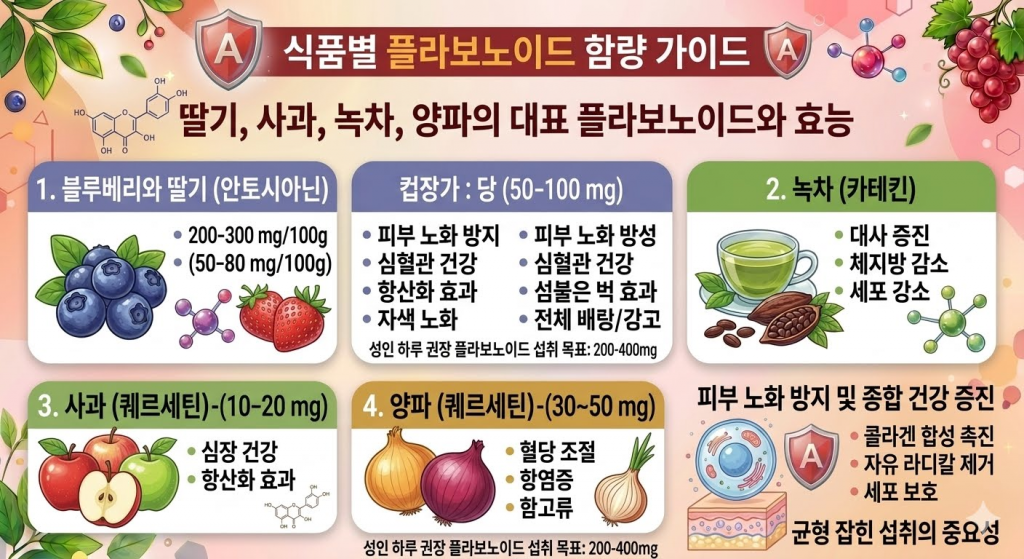
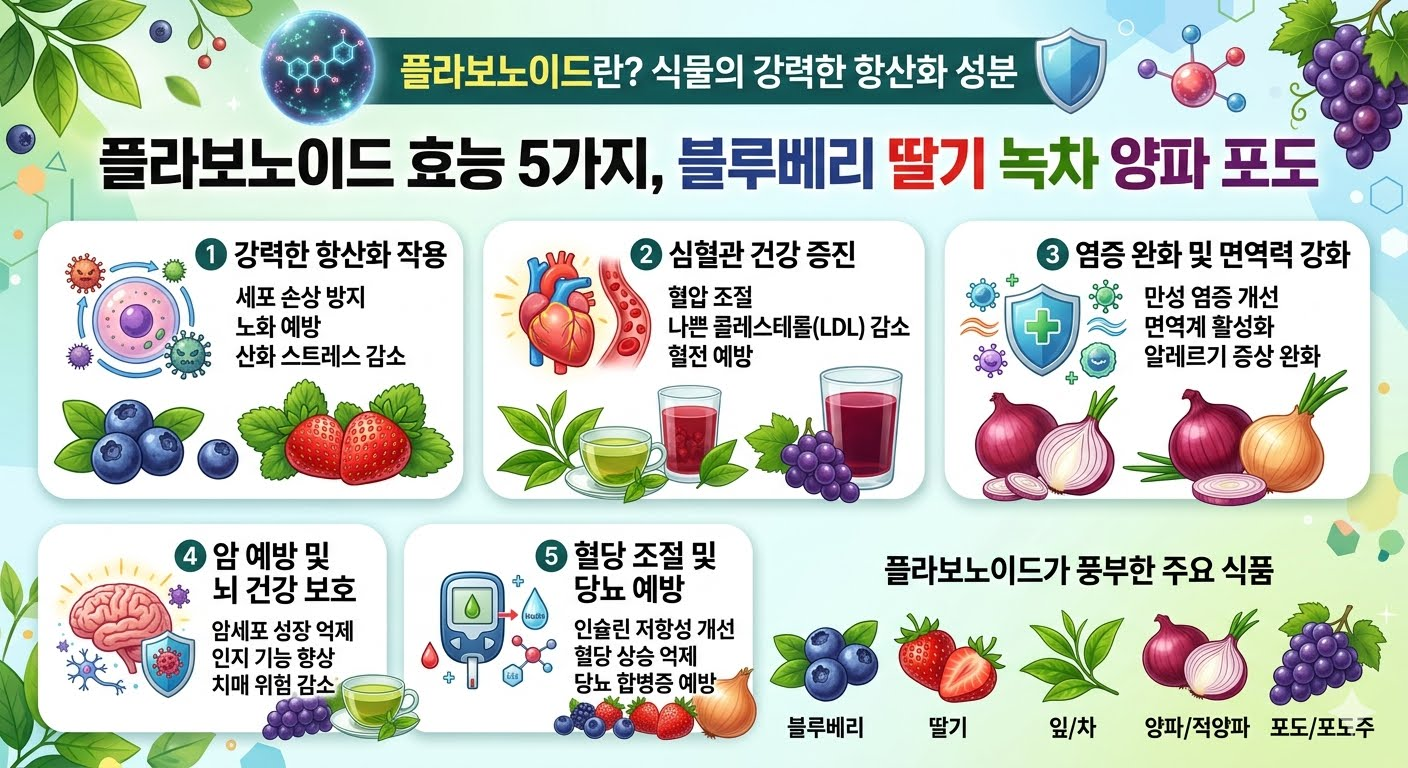
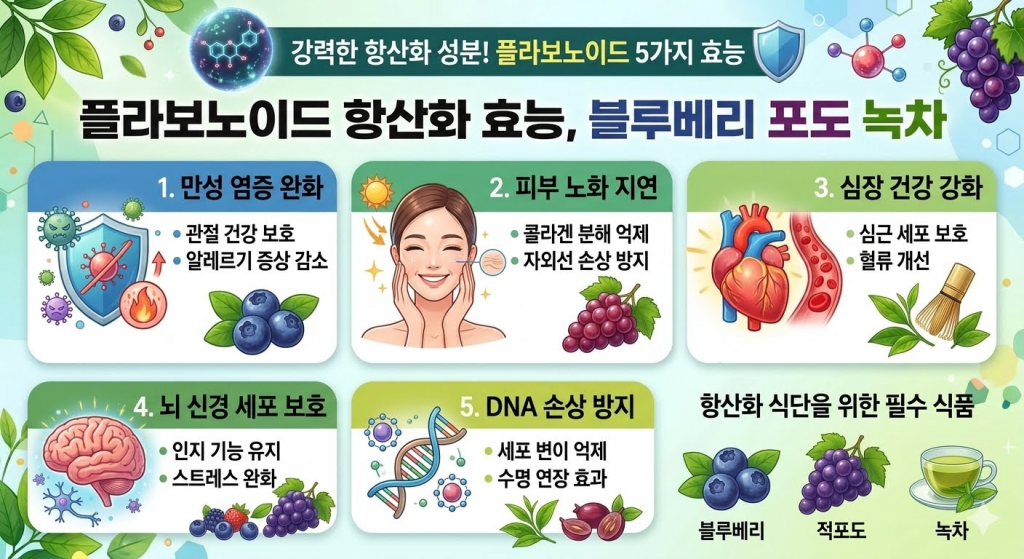
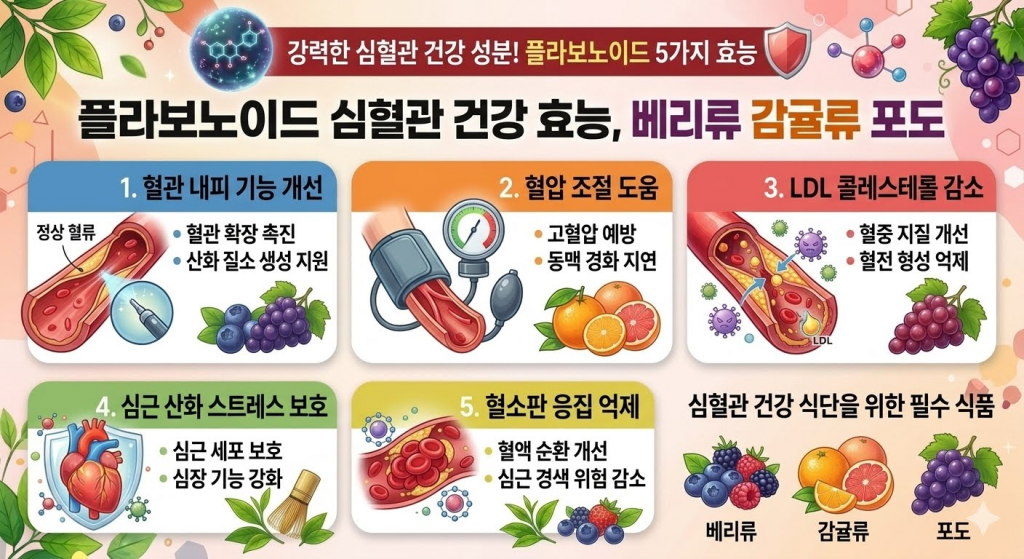
By now, many people know that flavonoids support anti-aging. But when it comes to the follow-up question — “So how much should I actually eat per day?” — most people draw a blank. Unlike vitamins or minerals, flavonoids are a nutrient category where clear intake guidelines aren’t widely known.
Flavonoids are antioxidants that, while not as well-known as vitamins and minerals by name, have the power to fight disease, prevent aging, and reduce inflammation — and once you know where to find them, they can create a dramatic shift in your health. (Source: Mercola Health Magazine)
The key issue is this: to see real anti-aging flavonoid results, you need to know the precise intake target. Eating too little limits the benefit, while vaguely assuming “more is better” can be an inefficient approach without a clear number to work toward.
Today, we break down the exact daily flavonoid intake — from the official Korean Ministry of Food and Drug Safety (MFDS) standard to international research findings — along with the anti-aging benefits and food-by-food intake strategies you need to hit your target.
Flavonoids are natural pigment compounds found in plants, classified as phytochemicals. The term doesn’t refer to a single specific compound — it’s an umbrella term covering hesperidin, rutin, quercetin, and many other related compounds.
Their high antioxidant activity helps eliminate the free radicals responsible for aging, and because they support capillary health by regulating vascular permeability, flavonoids were historically referred to as “Vitamin P.” (Source: Pillyze Pharmacist & Dietitian Guide)
Aging isn’t simply a function of time passing — it’s a cumulative process in which free radicals continuously attack cells and DNA, building up damage over years.
Flavonoids directly neutralize these free radicals, slowing the rate at which that damage accumulates. This is precisely why anti-aging flavonoids are considered a cornerstone of antioxidant nutrition.
📊 What Is the Actual Daily Flavonoid Intake You Need?
Official MFDS Standard – 16–17mg
The most authoritative reference point is the daily intake standard set by Korea’s Ministry of Food and Drug Safety (MFDS) for certifying health functional foods.
The officially recognized daily intake for antioxidant functionality is 16–17mg of total flavonoids. Health functional foods certified by the MFDS are standardized to deliver approximately 16–17mg of flavonoids per day. (Source: Pillyze Pharmacist & Dietitian Guide)
This 16–17mg figure represents the minimum legal threshold required to label a product as having “antioxidant function” — think of it as a baseline for general health maintenance, not a target for active anti-aging results.
For Active Anti-Aging and Disease Prevention – 500mg to 1,000mg
If your goal is meaningful anti-aging benefit or active disease prevention, you’ll need an intake well above the MFDS baseline.
A Danish study found that 500mg of daily flavonoid intake had a positive impact on cardiovascular disease risk, while for cancer-related mortality, a daily intake of 1,000mg was shown to lower the “hazard ratio” for cancer-related conditions. (Source: Mercola Health Magazine, Danish cohort study)
Notably, these threshold amounts are achievable through a normal, well-rounded diet within a single day — meaning you don’t need supplements to hit these effective intake levels. (Source: Mercola Health Magazine)
For Cognitive Protection – Approximately 600mg
If brain health and cognitive protection are your priority, there’s a separate benchmark to know. One study found that people who consumed approximately 600mg of flavonoids daily had a 20% lower risk of cognitive decline compared to those who consumed only 150mg. (Source: Kormedi Health Media)
📋 Daily Flavonoid Intake by Goal — At a Glance
Goal
Recommended Daily Intake
Source
Basic antioxidant function maintenance
16–17mg
MFDS health functional food certification standard
Cardiovascular disease prevention
500mg
Danish cohort study
Cognitive decline prevention
~600mg
International academic research
Reduced cancer-related disease risk
1,000mg
Danish cohort study
3 Core Anti-Aging Benefits of Flavonoids
① Free Radical Elimination – Blocking the Root Cause of Cellular Aging
The most central function of anti-aging flavonoids is free radical elimination. Free radicals attack cell membranes and DNA, acting as the primary accelerant of aging — and flavonoids directly neutralize these free radicals, preventing cellular damage before it accumulates.
② Capillary Health – Protecting Skin and Blood Vessels from Aging Simultaneously
Flavonoids help maintain healthy capillaries by regulating vascular permeability at an appropriate level. (Source: Pillyze Pharmacist & Dietitian Guide) Healthier blood vessels mean nutrients and oxygen reach skin cells more efficiently, contributing positively to slowing the visible signs of skin aging as well.
③ Cancer Prevention – Inhibiting the Growth of Specific Cancer Cells
Green tea is effective in preventing various cancers including leukemia, lung cancer, breast cancer, and prostate cancer. In particular, the compound epigallocatechin gallate found in green tea has shown the ability to inhibit the growth of breast, skin, and gastrointestinal cancers. (Source: Samsung Medical Center Health Information) This benefit is closely tied to the prevention of chronic diseases that are themselves deeply connected to the aging process.
How Much Food Do You Actually Need to Eat to Hit Your Daily Flavonoid Intake?
Raw numbers can feel abstract, so let’s translate them into real food.
Food
Flavonoid Content per Serving
Strawberries
~180mg per 100g
Apple
~113mg per apple
Green tea
~50–100mg per cup
Onion
~20–30mg per medium onion
Dark chocolate
~30–50mg per 30g
(Source: Kormedi Health Media, compiled)
Based on this breakdown, the 500mg cardiovascular prevention target is naturally achievable with a cup of strawberries (about 150g, ~270mg), an apple (113mg), and a cup of green tea (50–100mg). This means a meaningful anti-aging target is realistically reachable through normal daily meals — no special supplements required.
Why Flavonoids Matter Even More for Smokers and Heavy Drinkers
Anti-aging flavonoids aren’t equally important for everyone — for people with certain lifestyle factors, they matter significantly more.
The inverse relationship between total flavonoid intake and mortality rate was found to be more pronounced and stronger in smokers than in non-smokers, and stronger in heavy drinkers than in moderate drinkers. (Source: Mercola Health Magazine, compiled cohort research)
In other words, people with habits that generate higher levels of oxidative stress — such as smoking or heavy alcohol consumption — tend to experience a more pronounced benefit from flavonoid intake’s antioxidant action. To be clear, this is not a justification for smoking or heavy drinking — rather, it’s a signal that flavonoid intake becomes especially important for people with these habits, alongside efforts to reduce them.
Expert Cautions on Flavonoid Intake
Flavonoids obtained through food are very safe, but caution is warranted when choosing high-dose supplements. To see real results from a supplement, you need to take the dose supported by research findings — not just the minimum recommended intake. That said, when scientific evidence exists showing that excessive intake of a nutrient can cause harm, an upper safe limit is established to prevent overdose, so extra caution is needed when taking high-dose products or combining multiple supplements at once. (Source: Pillyze Pharmacist & Dietitian Guide)
Pregnant women in particular should consult a healthcare professional before taking high-dose flavonoid supplements, as research on this population remains limited. (Source: Pillyze Pharmacist & Dietitian Guide)Food-based intake remains the safest and most reliable way to reach these targets without that risk.
Check off what you ate today and roughly tally the milligrams. 500mg or more means you’ve hit the cardiovascular prevention target!
No.
Check Item
Approx. mg
Check
1
1 cup (150g) of strawberries
~270mg
☐
2
1 apple (skin on)
~113mg
☐
3
1 cup of green tea or matcha
~50–100mg
☐
4
A handful (half) of onion
~20–30mg
☐
5
30g of dark chocolate
~30–50mg
☐
6
1 piece of citrus fruit (orange/grapefruit)
~30–50mg
☐
7
If I drank or smoked today, I made a conscious effort to add extra flavonoid-rich foods
–
☐
Share your estimated total in the comments today — did you cross the 500mg mark?
Frequently Asked Questions (FAQ)
Q1. Why is there such a big gap between the MFDS standard of 16–17mg and the 500mg anti-aging target?
A. The 16–17mg figure is the minimum legal threshold required for a health functional food to be labeled as having “antioxidant function.” The 500–1,000mg range, on the other hand, reflects research-based intake levels associated with active health outcomes like cardiovascular and cancer prevention. The MFDS standard is useful as a baseline reference, but if your goal is meaningful anti-aging benefit, aiming for the higher intake range is recommended.
Q2. Wouldn’t it be more efficient to just take a supplement to hit 500mg at once?
A. Food-based intake is safer and more effective overall. Because different flavonoids act on different cellular targets, eating a variety of foods — strawberries, apples, green tea, onions — produces a synergistic effect that a single high-dose supplement can’t replicate. Whole food intake also carries virtually no risk of overconsumption.
Q3. Calculating 500mg every day feels like too much effort. What’s the bare minimum I should aim for?
A. If precise daily calculation feels overwhelming, set a simpler goal: include at least one fruit or vegetable of a different color at every meal. Strawberries or apple in the morning, onions or leafy greens at lunch and dinner, plus one daily cup of green tea — consistently doing just this can get you comfortably into the recommended range.
Q4. If I quit drinking and smoking, do I still need to worry about flavonoid intake?
A. Quitting smoking and drinking is one of the most effective choices for your health, but it doesn’t eliminate the need for flavonoids. Free radicals are also generated continuously by everyday factors like stress, UV exposure, and environmental pollution — so consistent flavonoid intake remains beneficial regardless of your drinking or smoking habits.
Q5. How long do I need to maintain this intake to see anti-aging results?
A. There’s no universally fixed timeframe, but antioxidant benefits tend to accumulate through long-term, consistent dietary habits rather than short bursts of high intake. Eating a moderate, steady amount every day is far more effective for anti-aging than eating large quantities occasionally.
Anti-aging flavonoids are no longer just a vague “they’re good for you” concept — now that you know the precise numbers, putting them into practice should feel much more achievable.
Start today with a cup of strawberries, an apple, and a cup of green tea, and work toward that 500mg daily intake target. It may look like a small number, but consistency adds up to a meaningful difference over time.
플라보노이드가 노화 방지에 좋다는 건 이제 많은 분들이 알고 계십니다. 그런데 정작 “그래서 하루에 얼마나 먹어야 하지?”라는 질문에는 명확히 답하기 어려우셨을 겁니다. 비타민이나 미네랄과 달리 플라보노이드는 권장량 기준이 잘 알려져 있지 않은 영양 성분입니다.
플라보노이드는 비타민과 미네랄 같이 이름이 잘 알려지지 않았지만, 질병을 퇴치하고 노화를 방지하며 염증을 감소시키는 힘을 가진 항산화제로서, 어디에서 찾는지만 안다면 건강에 극적인 변화를 만들 수 있습니다. (출처: Mercola 건강매거진)
문제는 노화 방지 플라보노이드의 효과를 보려면 정확한 섭취 기준을 아는 것이 중요하다는 점입니다. 너무 적게 먹으면 효과를 기대하기 어렵고, 막연히 “많이 먹으면 좋겠지”라는 생각만으로는 비효율적일 수 있습니다. 오늘은 플라보노이드 하루 권장량을 식약처 공식 기준부터 국제 연구 결과까지 명확하게 정리하고, 노화 방지 효능과 함께 음식별 섭취 방법까지 한 번에 알려드리겠습니다.
플라보노이드는 식물에 들어있는 색소 성분으로, ‘파이토케미컬’에 해당합니다. 하나의 특정한 성분을 말하는 것이 아니라 헤스페리딘·루틴·퀘르세틴 등 여러 종류를 통틀어 부르는 용어입니다.
항산화 작용이 높아 노화를 일으키는 활성산소를 없애는 작용을 하며, 모세혈관을 건강하게 하여 투과성을 높인다고 하여 과거에는 비타민P라고 불리기도 했습니다. (출처: 필라이즈 약사·영양사 가이드)
노화는 단순히 시간이 흐른다고 일어나는 것이 아니라, 활성산소가 세포와 DNA를 지속적으로 공격하며 손상을 누적시키는 과정입니다.
플라보노이드는 이 활성산소를 직접 중화시켜 노화 속도를 늦추는 역할을 합니다. 이것이 바로 노화 방지 플라보노이드가 항산화 식품의 핵심으로 꼽히는 이유입니다.
📊 플라보노이드 하루 권장량, 정확히 얼마일까?
식약처 공식 기준 – 16~17mg
가장 공신력 있는 국내 기준은 식품의약품안전처(식약처)의 건강기능식품 인증 기준입니다. 식약처에서 항산화 기능성을 인정받은 일일섭취량은 플라보노이드로서 16~17mg입니다.
식약처에서 인증받은 건강기능식품이라면 하루 플라보노이드 섭취량이 16~17mg 정도로 표준화되어 있습니다. (출처: 필라이즈 약사·영양사 가이드)
이 16~17mg은 ‘항산화 기능성’을 표시하기 위한 최소 기준선이며, 일상적인 건강 유지를 위한 기본값으로 이해하시면 됩니다.
노화 방지·질병 예방 목적 – 500mg~1,000mg
노화 방지 등 적극적인 건강 개선 효과를 원한다면 식약처 기준보다 훨씬 높은 섭취량이 필요합니다. 덴마크 연구는 500mg의 플라보노이드 섭취가 심혈관 질환에 긍정적인 영향을 끼쳤다고 밝혔으며, 암 관련 사망에 대해서는 하루 1,000mg의 섭취가 암 관련 질환의 위험 비율을 낮추는 것으로 나타났습니다. (출처: Mercola 건강매거진, 덴마크 코호트 연구)
흥미로운 점은 이 임계값 수치가 하루 동안 충분히 달성 가능한 식단 내에 존재한다는 것입니다. 즉 특별한 보충제 없이도 일상 식단으로 효과적인 섭취량에 도달할 수 있습니다. (출처: Mercola 건강매거진)
인지 기능 보호 목적 – 약 600mg
뇌 건강과 인지 기능 보호를 목표로 한다면 또 다른 기준이 있습니다. 한 연구에 따르면 하루 약 600mg의 플라보노이드를 섭취한 사람은 150mg을 섭취한 사람보다 인지 저하 위험이 20% 낮은 것으로 나타났습니다. (출처: 코메디닷컴)
📋 목적별 플라보노이드 하루 권장량 한눈에 보기
목적
하루 권장 섭취량
기준 출처
기본 항산화 기능 유지
16~17mg
식약처 건강기능식품 인증 기준
심혈관 질환 예방
500mg
덴마크 코호트 연구
인지 기능 저하 예방
약 600mg
국제 학술 연구
암 관련 질환 위험 감소
1,000mg
덴마크 코호트 연구
노화 방지 핵심 효능 3가지
① 활성산소 제거 – 세포 노화의 근본 원인 차단
노화 방지 플라보노이드의 가장 핵심적인 작용은 활성산소 제거입니다. 활성산소는 세포막과 DNA를 공격해 노화를 가속하는 주범인데, 플라보노이드는 이 활성산소를 직접 중화시켜 세포 손상을 막아줍니다.
② 모세혈관 건강 – 피부와 혈관 노화 동시 예방
플라보노이드는 모세혈관을 건강하게 하여 혈관 투과성을 적정 수준으로 유지하는 데 도움을 줍니다. (출처: 필라이즈 약사·영양사 가이드) 혈관이 건강해지면 영양분과 산소가 피부 세포까지 원활하게 공급되어, 피부 노화 속도를 늦추는 데도 긍정적인 영향을 미칩니다.
③ 암 예방 – 특정 암세포 성장 억제
녹차는 백혈병, 폐암, 유방암, 전립선암 등 다양한 암 예방에 효과적인데, 특히 녹차의 에피갈로카테킨 갈레이트라는 성분이 유방암, 피부암, 위장관 암의 성장을 억제하는 효과가 있습니다. (출처: 삼성서울병원 건강정보) 이는 노화와 밀접하게 연관된 만성 질환 예방에도 직결되는 효능입니다.
플라보노이드 하루 권장량, 음식으로는 얼마나 먹어야 할까?
수치만 보면 막막하실 수 있으니, 실제 음식으로 환산해 보겠습니다.
음식
1회 섭취량당 플라보노이드 함량
딸기
100g당 약 180mg
사과
1개당 약 113mg
녹차
1잔당 약 50~100mg
양파
중간 크기 1개당 약 20~30mg
다크초콜릿
30g당 약 30~50mg
(출처: 코메디닷컴 종합)
이를 바탕으로 계산하면, 심혈관 질환 예방 목표치인 500mg은 딸기 한 컵(약 150g, 270mg)에 사과 한 개(113mg), 녹차 한 잔(50~100mg)을 더하면 자연스럽게 도달할 수 있는 수준입니다. 특별한 보충제 없이도 일상 식사로 충분히 실현 가능한 목표라는 의미입니다.
흡연자·음주자에게 플라보노이드가 더 중요한 이유
노화 방지 플라보노이드가 모두에게 똑같이 중요한 것은 아닙니다. 특정 생활습관을 가진 분들에게는 훨씬 더 절실합니다.
총 플라보노이드 섭취와 사망률의 반비례 관계는 비흡연자보다 흡연자에게 더 뚜렷하고 강하게 나타났으며, 적당한 양의 음주를 하는 사람보다 심한 음주를 하는 사람에게서 더 강하게 나타났습니다. (출처: Mercola 건강매거진, 코호트 연구 종합)
즉 흡연이나 과도한 음주처럼 산화 스트레스를 많이 유발하는 습관을 가진 분들일수록, 플라보노이드 섭취를 통한 항산화 작용의 효과가 더 크게 나타난다는 의미입니다. 물론 이는 흡연과 음주를 정당화하는 근거가 아니라, 해당 습관이 있는 분들에게 플라보노이드 섭취가 더욱 중요하다는 신호로 받아들이시는 것이 정확합니다.
전문가가 말하는 플라보노이드 섭취 시 주의사항
플라보노이드는 음식으로 섭취할 경우 매우 안전하지만, 고함량 보충제를 선택할 때는 주의가 필요합니다.
영양제의 효과를 보기 위해서는 권장섭취량이 아닌, 연구 결과에 근거한 용량을 섭취해야 합니다. 다만 영양소를 너무 많이 먹었을 때 건강에 유해한 영향을 준다는 과학적 근거가 있는 경우에는 과다증이 나타나지 않도록 상한섭취량이 정해져 있으니, 고함량 제품이나 여러 영양제를 동시에 복용할 때는 주의가 필요합니다. (출처: 필라이즈 약사·영양사 가이드)
특히 임산부의 경우 고함량 플라보노이드 보충제에 대한 연구가 부족하므로 전문가와 상담 후 섭취하시길 권장드립니다. (출처: 필라이즈 약사·영양사 가이드) 음식을 통한 섭취는 이러한 우려 없이 안전하게 실천할 수 있는 가장 확실한 방법입니다.
오늘 섭취한 항목을 체크하고 대략적인 mg을 합산해보세요. 500mg 이상이면 심혈관 질환 예방 목표 달성!
번호
체크 항목
예상 mg
체크
1
딸기 한 컵(150g) 섭취
약 270mg
☐
2
사과 1개 (껍질째) 섭취
약 113mg
☐
3
녹차 또는 말차 1잔 섭취
약 50~100mg
☐
4
양파 한 줌(반 개) 섭취
약 20~30mg
☐
5
다크초콜릿 30g 섭취
약 30~50mg
☐
6
오렌지·자몽 등 감귤류 1개 섭취
약 30~50mg
☐
7
음주·흡연을 했다면 의식적으로 플라보노이드 식품을 추가 섭취했다
–
☐
오늘의 예상 총 섭취량을 댓글로 공유해주세요! 500mg을 넘기셨나요?
자주 묻는 질문 (FAQ)
Q1. 식약처 기준인 16~17mg과 노화 방지 목표인 500mg, 왜 이렇게 차이가 크나요?
A. 16~17mg은 건강기능식품의 ‘항산화 기능성’을 표시하기 위한 최소 법적 기준선입니다. 반면 500mg~1,000mg은 심혈관 질환·암 예방 등 적극적인 건강 효과를 목표로 한 연구 기반 수치입니다. 일상적인 건강 유지에는 식약처 기준이 참고가 되지만, 노화 방지 등 적극적인 효과를 원한다면 더 높은 섭취량을 목표로 하시는 것이 좋습니다.
Q2. 영양제로 한 번에 500mg을 채우는 것이 더 효율적이지 않나요?
A. 음식을 통한 섭취가 더 안전하고 효율적입니다. 플라보노이드는 종류마다 작용하는 세포 내 작용점이 다르기 때문에, 한 가지 고함량 보충제보다 딸기·사과·녹차·양파처럼 다양한 식품을 통해 골고루 섭취하는 것이 시너지 효과를 높입니다. 또한 음식 섭취는 과잉 섭취 위험이 거의 없습니다.
Q3. 매일 500mg씩 챙겨 먹기가 너무 번거로운데, 최소한 어느 정도는 먹어야 하나요?
A. 매일 정확히 계산하기 어렵다면, 매끼 한 가지 이상의 과일이나 채소를 색깔별로 다르게 챙기는 것을 목표로 삼으세요. 아침에 딸기나 사과, 점심·저녁에 양파나 녹색 채소, 그리고 하루 한 잔의 녹차만 꾸준히 실천해도 권장 범위에 충분히 도달할 수 있습니다.
Q4. 술이나 담배를 끊으면 플라보노이드를 덜 챙겨도 되나요?
A. 금연·금주는 건강에 가장 효과적인 선택이지만, 그렇다고 플라보노이드 섭취가 필요 없어지는 것은 아닙니다. 활성산소는 음주·흡연 외에도 스트레스·자외선·환경오염 등 일상적인 요인으로도 지속적으로 발생하므로, 생활습관과 무관하게 꾸준한 플라보노이드 섭취는 권장됩니다.
Q5. 노화 방지 효과를 보려면 얼마나 꾸준히 섭취해야 하나요?
A. 명확한 기간이 정해져 있지는 않지만, 항산화 효과는 단기간의 섭취보다 장기적이고 꾸준한 식습관을 통해 누적되는 경향이 있습니다. 일회성으로 많이 먹기보다, 매일 적정량을 지속적으로 섭취하는 습관이 노화 방지에 훨씬 효과적입니다.
노화 방지 플라보노이드, 막연히 “좋다더라”가 아니라 이제 정확한 수치를 아셨으니 실천하기도 훨씬 쉬워지셨을 겁니다.
오늘부터 딸기 한 컵, 사과 한 개, 녹차 한 잔으로 하루 권장량 500mg에 도전해보세요. 작은 숫자처럼 보여도, 매일 쌓이면 분명한 차이를 만듭니다.
Flavonoid benefits — you may have heard the term, but do you know exactly what they are, which foods contain them, and how much you actually need? Unlike well-known nutrients like vitamin C or omega-3, flavonoids are powerful health compounds already hiding in the fruits, vegetables, and green tea you eat every day.
Flavonoids are natural compounds found in plants that provide a wide range of health benefits through antioxidant activity. Key benefits include anti-inflammatory, anti-cancer, cardiovascular health promotion, and immune system strengthening effects. Major flavonoids include quercetin, catechin, isorhamnetin, and anthocyanin. (Source: Kormedi Health Media)
What makes flavonoid benefits especially relevant today is their connection to the slow aging movement. Free radicals — unstable molecules produced during energy metabolism — can cause oxidative damage that leads to chronic disease and accelerated aging. Flavonoids directly neutralize these free radicals at the cellular level. (Source: Samsung Medical Center Health Information)
Today, we break down 5 core flavonoid benefits, the best flavonoid-rich foods to eat, and exactly how to maximize their effects in your daily diet.
Flavonoids are the natural pigments responsible for the vivid colors of the foods we eat — the deep purple of blueberries, the red of strawberries, the green of matcha, and the orange of citrus fruits. For plants, flavonoids serve as a defense system against UV rays, insects, and oxidative stress. For humans, they function as potent antioxidant and anti-inflammatory compounds.
Flavonoids have been shown to possess a wide range of biological and pharmacological activities, including anti-allergic, anti-inflammatory, antioxidant, antimicrobial (antibacterial, antifungal, antiviral), and anti-cancer properties. (Source: Wikipedia — Flavonoid)
Here’s a quick overview of the main flavonoid types and their primary food sources:
(Source: Samsung Medical Center Health Information, Kormedi Health Media)
Flavonoid Benefit 1. Powerful Antioxidant Protection – Stop Cellular Aging at the Source
The most fundamental of all flavonoid benefits is antioxidant activity. Every moment your body produces energy, it also generates free radicals as byproducts. When these accumulate in excess, they damage cell membranes and DNA — accelerating aging and triggering disease.
The flavonoids found in red wine made from red grapes act as exceptionally powerful antioxidants. Antioxidant activity refers to the neutralization of free radicals that attack important molecules in the body and cause harmful effects. (Source: Samsung Medical Center Health Information)
Flavonoids have demonstrated antioxidant, anti-cancer, antibacterial, cardioprotective, anti-inflammatory, immune-enhancing, and skin-protective effects across international research. (Source: Kormedi Health Media, compiled from Scopus and PubMed research databases)
Best foods: Blueberries, strawberries, grapes, red wine (in moderation), green tea, dark chocolate
Flavonoid Benefit 2. Anti-Inflammatory Action – Cut Chronic Inflammation at the Root
Chronic inflammation is now recognized as a common underlying cause of most major modern diseases — including diabetes, cancer, cardiovascular disease, and dementia. Flavonoids are among the most effective natural compounds for suppressing this chronic inflammation.
The antioxidant and anti-inflammatory effects of flavonoids found in natural plant extracts have been confirmed through research.
Specific flavonoid compounds including apigenin, baicalein, genistein, naringenin, hesperetin, proanthocyanidins, quercetin, and kaempferol have all demonstrated antioxidant and anti-inflammatory effects in published studies. (Source: Korea Institute of Science and Technology Information (KISTI), Korean Society of Cosmetics and Cosmetology Journal)
In the context of modern diets high in sugar and processed foods — both of which promote systemic inflammation — consistently eating flavonoid-rich vegetables and fruits is one of the most practical ways to reduce chronic inflammation levels without medication.
Best foods: Onions (quercetin), broccoli, kale, green tea (catechin), turmeric, ginger
Flavonoids show particularly strong protective effects on heart and vascular health. According to a 2013 study, people who ate blueberries or strawberries three or more times per week had a 32% lower risk of heart attack compared to those who ate them less frequently.
The anthocyanins and other flavonoids found in berries lower blood pressure and dilate blood vessels to produce these protective effects. (Source: Korean Society of Food Science and Nutrition, Kormedi Health Media)
Anthocyanin-rich fruits such as strawberries and berries help prevent high blood pressure and cardiovascular disease, and have also demonstrated anti-cancer effects — particularly for breast and colorectal cancer prevention. (Source: Samsung Medical Center Health Information)
Hesperidin, abundant in citrus fruits, helps prevent heart disease and strengthens blood vessels. Quercetin, a plant-based flavonoid pigment, protects blood vessel walls from damage. (Source: Samsung Medical Center Health Information, Kormedi Health Media)
Best foods: Strawberries, blueberries, cherries (anthocyanin), oranges, grapefruit, lemons (hesperidin), onions, apples (quercetin), grapes (resveratrol)
Flavonoid Benefit 4. Brain Health Protection – Slow Cognitive Decline
As we age, memory loss and cognitive decline become growing concerns. Among all flavonoid benefits, brain health protection is one of the most actively researched areas in recent years.
Research shows that people who consumed approximately 600mg of flavonoids per day had a 20% lower risk of cognitive decline compared to those who consumed only 150mg per day. Flavonoids are primarily found in the skins of fruits and vegetables. (Source: Kormedi Health Media, April 2026)
As antioxidant nutrients, flavonoids help maintain healthy blood flow to the brain and protect against stroke and heart attack. They have also been shown to protect brain cells from the type of cell loss that affects Parkinson’s disease patients. (Source: Busan Metropolitan City Health Information)
Flavonoids found in vegetables such as chili peppers and bell peppers are particularly helpful in preventing cognitive decline. Berries like strawberries and blueberries that can be eaten with their skin intact are especially rich in flavonoids. A single apple contains approximately 113mg of flavonoids, while 100g of strawberries contains approximately 180mg. (Source: Kormedi Health Media)
Best foods: Blueberries, strawberries (anthocyanin), spinach (luteolin), chili peppers, bell peppers (luteolin), apples (quercetin), green tea (catechin)
Flavonoids are one of the most actively studied natural compounds in cancer prevention research.
Clinical cases reporting that flavonoids can suppress cancer recurrence have emerged in recent years. While bioavailability remains low, flavonoids demonstrate excellent efficacy and safety profiles, with each individual flavonoid acting on different cellular targets — making combination approaches a promising research direction. (Source: Korea Institute of Science and Technology Information (KISTI), Flavonoid Anti-Cancer Research Paper)
Quercetin, found abundantly in cherries, apples, and onions, protects blood vessel walls from damage. Perillyl alcohol, also found in cherries, has been shown to inhibit the growth of prostate cancer cells. (Source: Kormedi Health Media)
Tangeretin, found in citrus fruits, is associated with the prevention of certain brain and bronchial cancers. (Source: Samsung Medical Center Health Information)
Important note: Most anti-cancer research on flavonoids to date has been conducted at the cellular (in vitro) level, with human clinical trials still ongoing in many areas. Flavonoids should be understood as a preventive dietary strategy, not as a cancer treatment. (Source: Wikipedia — Flavonoid, European Food Safety Authority (EFSA) research summary)
Best foods: Oranges, grapefruit, limes (tangeretin), cherries (quercetin, perillyl alcohol), onions, apples (quercetin), grapes, strawberries (anthocyanin)
Top 10 Flavonoid-Rich Foods
Rank
Food
Key Flavonoid
Core Benefit
1
Blueberries
Anthocyanin
Antioxidant, cardiovascular, brain health
2
Strawberries
Anthocyanin (180mg/100g)
Cardiovascular, cognitive function, anti-cancer
3
Green Tea
Catechin
Antioxidant, antibacterial, brain health
4
Onions
Quercetin
Anti-inflammatory, blood vessel protection
5
Oranges & Grapefruit
Hesperidin, Tangeretin
Heart protection, anti-cancer
6
Grapes
Resveratrol, Anthocyanin
Blood circulation, antioxidant
7
Cherries
Quercetin, Anthocyanin
Anti-inflammatory, anti-cancer, sleep support
8
Spinach
Luteolin
Stroke prevention, cognitive function
9
Chili & Bell Peppers
Luteolin
Cognitive decline prevention
10
Tofu & Doenjang (Miso)
Isoflavone
Antioxidant, hormonal balance
(Source: Samsung Medical Center Health Information, Kormedi Health Media, Busan Metropolitan City Health Information)
How to Get the Most Out of Flavonoids
① Daily Intake Reference
The Korea Ministry of Food and Drug Safety (MFDS) has recognized a daily intake of 16–17mg of flavonoids for antioxidant function. For cognitive protection, research suggests a daily intake of around 600mg shows meaningful effects. (Source: Pillyze Pharmacist & Dietitian Guide, Kormedi Health Media)
② Eat the Skin — It’s Where Flavonoids Concentrate
Flavonoids are most concentrated in the skins of fruits and vegetables. Eat strawberries and blueberries whole, and wash apples thoroughly to eat them with the skin on for maximum flavonoid intake. (Source: Kormedi Health Media)
③ Eat a Rainbow — Variety Beats Quantity
Each flavonoid type acts on different cellular targets inside the body. Rather than focusing on a single superfood, aim to eat a wide variety of red, purple, orange, and green fruits and vegetables every day for a synergistic, broad-spectrum effect. (Source: Korea Institute of Science and Technology Information (KISTI))
④ Raw or Minimally Cooked is Best
Some flavonoids are partially destroyed by heat. Whenever possible, eat fruits and vegetables raw, or cook them as briefly as possible. Blanch broccoli for no more than 2 minutes, and try eating onions sliced thin and raw rather than stir-fried.
⑤ Green Tea: 2–3 Cups Per Day Is Optimal
Green tea’s catechins are outstanding for brain health and antioxidant protection. Some studies suggest that a single cup of matcha contains at least 3 times more antioxidant compounds than regular green tea — making matcha an excellent option for those who aren’t sensitive to caffeine. (Source: Vogue Korea, Antioxidant Foods Feature)
Expert Cautions on Flavonoid Intake
According to research by the Linus Pauling Institute and the European Food Safety Authority (EFSA), flavonoids are poorly absorbed by the human body (less than 5%), and most of what is absorbed is rapidly metabolized and excreted. (Source: Wikipedia — Flavonoid)
This means food-based flavonoid intake is safe and effective, but high-dose supplementation over extended periods warrants caution. Individuals taking blood-thinning medications or with specific medical conditions should consult a physician or pharmacist before using flavonoid supplements.
Flavonoids from whole foods carry virtually no risk of overconsumption — making a daily habit of eating diverse, colorful fruits and vegetables the safest and most effective long-term strategy.
Check off what you practiced today. 6 or more means your flavonoid intake is on track!
No.
Check Item
Check
1
Ate a handful of blueberries, strawberries, or other berries
☐
2
Had at least 1 cup of green tea or matcha
☐
3
Ate an apple, orange, or grapefruit with the skin on
☐
4
Included onion, bell pepper, or chili in a meal or salad
☐
5
Ate broccoli, spinach, or another dark leafy green
☐
6
Had tofu, doenjang (miso), or another fermented soy food
☐
7
Ate vegetables or fruits in at least 3 different colors today
☐
8
Replaced a processed snack with fresh fruit
☐
Share your checklist score in the comments — we’d love to know how many you’re already doing!
Frequently Asked Questions (FAQ)
Q1. Is it more effective to take flavonoids as a supplement rather than through food?
A. Food-based intake is far safer and more naturally bioavailable. Flavonoids tend to work synergistically with other nutrients found in whole foods, making fruit and vegetable sources more effective than isolated supplements in most cases. If you’re considering supplementation, consult a pharmacist or physician first. (Source: Pillyze Pharmacist & Dietitian Guide)
Q2. Do flavonoids lose their benefits when cooked?
A. Some flavonoids are heat-sensitive and may degrade with prolonged cooking, though this varies by compound type. Eating raw or minimally cooked is generally best. When cooking is needed, keep it brief — blanch or stir-fry for 2 minutes or less to preserve as much flavonoid content as possible.
Q3. How much flavonoid-rich food do I need to eat each day to see a difference?
A. The MFDS-recognized daily functional dose is 16–17mg for antioxidant benefits, while cognitive protection research points to around 600mg per day as beneficial. (Source: Pillyze, Kormedi Health Media) Given that 100g of strawberries contains approximately 180mg and a single apple contains around 113mg, eating a diverse mix of fruits and vegetables daily can easily meet these targets naturally.
Q4. Are blueberries or strawberries better for flavonoid intake?
A. Strawberries contain approximately 180mg of flavonoids per 100g — placing them among the highest flavonoid-density fruits alongside blueberries. (Source: Kormedi Health Media) Rather than choosing one over the other, alternating between both gives you exposure to a broader spectrum of flavonoid types and maximizes the overall protective effect.
Q5. Are there any side effects or risks from eating too many flavonoids?
A. Consuming flavonoids through whole foods carries virtually no risk of overconsumption and is considered very safe. However, high-dose flavonoid supplements taken over extended periods may interact with certain medications — particularly blood thinners. Anyone taking prescription medications or managing a chronic condition should consult their doctor or pharmacist before adding flavonoid supplements to their routine. (Source: Wikipedia — Flavonoid, European Food Safety Authority (EFSA) research summary)
Flavonoid benefits are within reach every single day — no expensive supplements required.
A handful of blueberries, a cup of green tea, an apple eaten skin-on. These small, consistent choices deliver antioxidant protection, fight chronic inflammation, support your heart and brain, and may even help prevent cancer over the long term. Start with just one item from today’s checklist and build from there.